Reported from Photonics.com: Scientists have used ultrashort laser pulses to trigger electrical activity in thunderclouds, a first step toward creating man-made lightning.
In a modern-day take on Benjamin Franklin's experiment during a storm more than 200 years ago with a kite, a key and a silk ribbon to prove electricity exists in the atmosphere, the French, Swiss and German scientists aimed high-power pulses of laser light into two passing thunderstorms at the top of South Baldy Peak in New Mexico. The laser pulses created plasma filaments that could conduct electricity. No air-to-ground lightning was triggered because the plasma filaments were too short-lived, but the laser pulses generated discharges in the thunderclouds themselves, the scientists said.
Triggering lightning strikes is an important tool for basic and applied research because it enables researchers to study the mechanisms underlying lightning strikes. Triggered lightning strikes will also allow engineers to evaluate and test the lightning sensitivity of airplanes and critical infrastructure such as power lines.
The idea of using lasers to trigger lightning strikes was first suggested more than 30 years ago, but until recently lasers were not powerful enough to generate the long plasma channels needed. The current generation of more powerful pulsed lasers, like the one developed by Kasparian's team, may change that because they can form a large number of plasma filaments -- ionized channels of molecules in the air that act like conducting wires extending into the thundercloud.
Kasparian and his colleagues involved in the Teramobile project, an international program initiated by the National Center for Scientific Research (CNRS) in France and the German Research Foundation (DFG), built a powerful mobile femtosecond-terawatt laser capable of generating long plasma channels by firing ultrashort laser pulses. They chose to test their laser at the Langmuir Laboratory in New Mexico, which is equipped to measure atmospheric electrical discharges. Sitting at the top of 10,500-ft South Baldy Peak, this laboratory is in an ideal location because its altitude places it close to the high thunderclouds.
During the tests, the research team quantified the electrical activity in the clouds after discharging laser pulses. Statistical analysis showed that their laser pulses indeed enhanced the electrical activity in the thundercloud where it was aimed—in effect they generated small local discharges located at the position of the plasma channels.
The limitation of the experiment, though, was that they could not generate plasma channels that lived long enough to conduct lightning all the way to the ground. The plasma channels dissipated before the lightning could travel more than a few meters along them. The team is currently looking to increase the power of the laser pulses by a factor of 10 and use bursts of pulses to generate the plasmas much more efficiently.
The paper, "Electric Events Synchronized With Laser Filaments in Thunderclouds," appears in the April 14 issue of Optics Express, the Optical Society of America's (OSA) open-access journal.
Monday, April 14, 2008


Wednesday, April 09, 2008
Petawatt Power Peak Reached
 The Texas Petawatt laser produced a petawatt of peak power on March 31, making it the highest powered laser in the world, said Todd Ditmire, a physicist at the University of Texas at Austin.
There has only been one petawatt laser in the US history, the Nova laser at Lawrence Livermore Laboratory (LLNL, operated by the University of California for the energy department). Nova, which took up a football field in space, is now defunct. In the past eight or so years, there has been a worldwide push to achieve petawatts (10 to the 15th power). Terawatts (10 to the 12th power) were produced by short pulse lasers in the late 1980s using chirped pulse amplification, the method Ditmire is using.
Other US petawatt projects include the OmegaEP laser at the University of Rochester, The Ohio State University petawatt, and the Z-Beamlet project at the Sandia National Labs Z-Petawatt Laser Facility. Projects are also underway in the UK, France, Germany, Japan, China, and other countries.
The challenge for researchers is to produce a lot of energy in a little time, and a petwatt can be the result if enough energy can be produced in a short enough pulse. The Hercules laser at the University of Michigan, for example, is only 0.3 petawatts, but it focuses to an incredibly tiny spot. For sheer power -- energy divided by pulse duration -- the Texas petawatt laser now leads the way in the US.
The laser produces a very short duration, very low-energy pulse, and this pulse is stretched in time to a very long pulse, is amplified to huge energy, then finally is compressed to a high-energy, super-short-duration pulse. One of the critical aspects of the system is the diffraction gratings used to compress the pulse; these were made by Jerry Britten's group at LLNL, and they are some of the most difficult-to-manufacture optics in the world.
Related Link: Texas High Intensity Laser
via: photonics.com
Wednesday, March 05, 2008
Petawatt laser approaches diffraction limit
A French team has combined adaptive optics (AO) with an elaborate alignment system to effectively correct wavefront aberrations in a high peak-power laser, achieving focal spots close to the diffraction limit. "The optimization procedure produces a considerable improvement in focal spot quality with a Strehl ratio of 0.7 for full-energy kilojoule shots," Ji-Ping Zou of the LULI laboratory told optics.org. "The procedure, once integrated into our control system, is straightforward and there are no operational penalties." (Applied Optics 47 704.)
 Spatial phase and focal spot measurements using a low-energy pulsed probe before the fourth shot of a kJ shot sequence (5 shots, one shot every hour): a) and b): before and after the closed-loop convergence. c) Focal spot measurement during the fourth shot.
The LULI (Laboratoire pour l'Ulilisation des Lasers Intenses) laser delivers kilojoule pulses in the nanosecond range at 1053 nm, and is capable of reaching the petawatt regime through chirped pulse amplification.

The first category of aberrations is minimized by precise beam realignment between two successive shots, combined with a closed-loop AO system employing a bimorph deformable mirror with 32 actuators. An additional semi-automatic realignment of beam pointing and centring between shots controls the second category, while the AO system tackles the third group. The right is the schematic of the four amplification stages of the LULI2000. A bimorph deformable mirror is implemented between the second and the third stages. A wavefront sensor is positioned at the chain output.
The result has been reproducible focal spots close to the diffraction limit for full-energy kilojoule shots fired at one shot per hour. Zou's group has achieved a focal spot with a Strehl ratio - a measure of the fractional drop in light intensity as a function of wavefront error - of 0.7. The focal intensity can therefore reach 2.2 x 10¹⁸ W/cm2 in the kilojoule per nanosecond range, and intensities as high as 1021 W/cm2 are foreseen by Zou. Shot-to-shot reproducibility of the focal spot is said to be excellent, which is very important for laser-matter interaction experiments.
via Optics.org
 Spatial phase and focal spot measurements using a low-energy pulsed probe before the fourth shot of a kJ shot sequence (5 shots, one shot every hour): a) and b): before and after the closed-loop convergence. c) Focal spot measurement during the fourth shot.
The LULI (Laboratoire pour l'Ulilisation des Lasers Intenses) laser delivers kilojoule pulses in the nanosecond range at 1053 nm, and is capable of reaching the petawatt regime through chirped pulse amplification.

The first category of aberrations is minimized by precise beam realignment between two successive shots, combined with a closed-loop AO system employing a bimorph deformable mirror with 32 actuators. An additional semi-automatic realignment of beam pointing and centring between shots controls the second category, while the AO system tackles the third group. The right is the schematic of the four amplification stages of the LULI2000. A bimorph deformable mirror is implemented between the second and the third stages. A wavefront sensor is positioned at the chain output.
The result has been reproducible focal spots close to the diffraction limit for full-energy kilojoule shots fired at one shot per hour. Zou's group has achieved a focal spot with a Strehl ratio - a measure of the fractional drop in light intensity as a function of wavefront error - of 0.7. The focal intensity can therefore reach 2.2 x 10¹⁸ W/cm2 in the kilojoule per nanosecond range, and intensities as high as 1021 W/cm2 are foreseen by Zou. Shot-to-shot reproducibility of the focal spot is said to be excellent, which is very important for laser-matter interaction experiments.
via Optics.org
Friday, February 29, 2008
Protons bring fusion into view
Researchers in the US have now developed an imaging technique that could help bring fusion power to fruition. Richard Petrasso and colleagues at the Massachusettes Institute of Technology and Wolfgang Theobold and colleagues at the University of Rochester have used "proton radiography" to map the electromagnetic structure of the extremely hot, dense plasmas in which fusion reactions take place. The technique has revealed hitherto unseen magnetic and electric fields, and could help researchers to get fusion plasmas to ignite—the key to electricity generation.
The MIT-Rochester technique applies to inertial-confinement fusion (ICF), which is one of two possible routes to a fusion reactor. The idea behind ICF is to bombard fuel capsules (typically containing deutrium and tritium) with high-powered laser pulses so that they implode, generating a small volume of hot, dense plasma in which the deutrium and tritium nuclei can overcome their electrical replusion and produce a helium nucleus plus a free neutron. Since these reaction products are lighter than the original nuclei, copious energy is released via Einstein's mass-energy equivalence.
In the new work, the MIT and Rochester researchers used 36 beams at the high-powered OMEGA laser facility at Rochester to symmetrically implode ICF fuel capsules (Science 319 1223). The same beams also struck a different capsule 1 cm away which was filled with deuterium and helium-3 gas. Protons released from this "backlighter" capsule all have the same (known) energy, so by measuring the deflection of the positively charged protons that had transited some plasma the team was able to map the electromagentic fields present in ICF implosions for the first time.

Diagram of the experiment used to image the plasma. Protons from the backlighter capsule (left) travel through the target capsule before their position and energy is determined by a detector. (Courtesy: Science)
The MIT-Rochester technique applies to inertial-confinement fusion (ICF), which is one of two possible routes to a fusion reactor. The idea behind ICF is to bombard fuel capsules (typically containing deutrium and tritium) with high-powered laser pulses so that they implode, generating a small volume of hot, dense plasma in which the deutrium and tritium nuclei can overcome their electrical replusion and produce a helium nucleus plus a free neutron. Since these reaction products are lighter than the original nuclei, copious energy is released via Einstein's mass-energy equivalence.
In the new work, the MIT and Rochester researchers used 36 beams at the high-powered OMEGA laser facility at Rochester to symmetrically implode ICF fuel capsules (Science 319 1223). The same beams also struck a different capsule 1 cm away which was filled with deuterium and helium-3 gas. Protons released from this "backlighter" capsule all have the same (known) energy, so by measuring the deflection of the positively charged protons that had transited some plasma the team was able to map the electromagentic fields present in ICF implosions for the first time.

Diagram of the experiment used to image the plasma. Protons from the backlighter capsule (left) travel through the target capsule before their position and energy is determined by a detector. (Courtesy: Science)
Monday, February 25, 2008
Electron filmed for first time ever
 Now it is possible to see a movie of an electron. The movie shows how an electron rides on a light wave after just having been pulled away from an atom. This is the first time an electron has ever been filmed, and the results are presented in the latest issue of Physical Review Letters.
Previously it has been impossible to photograph electrons since their extremely high velocities have produced blurry pictures. In order to capture these rapid events, extremely short flashes of light are necessary, but such flashes were not previously available. With the use of a newly developed technology for generating short pulses from intense laser light, so-called attosecond pulses, scientists at the Lund University Faculty of Engineering in Sweden have managed to capture the electron motion for the first time.
View video: avi or mov.
More information: http://www.atto.fysik.lth.se/
Tuesday, February 19, 2008
The most intense laser pulse in the universe
 The people on HERCULES laser at the University of Michigan has claimed to have created the most intense laser pulse in the universe.
The record-setting beam measures 20 billion trillion watts per square centimeter. It contains 300 terawatts of power, about 300 times the capacity of the entire US electricity grid. The laser beam’s power is concentrated to a 1.3-µm speck about 100th the diameter of a human hair. To achieve this beam, the research team added another amplifier to HERCULES (high-energy repetitive CUOS laser system) laser system, which previously operated at 50 terawatts.
Wednesday, February 13, 2008
Femtosecond laser creates subsurface structures
Reported by optic.org

German researchers have used an ultrashort pulsed laser to create subsurface nanostructures in a sapphire crystal. The team believes that the techniques could be used to fabricate microfluidic devices as well as 3D photonic structures. (Optics Express 16 1517.)
SEM images of the entrance of the modified and etched channel directly after etching (left) and cross section of hollow nanoplanes in 500 μm depth of the same track. Laser beam propagated from top to bottom, three parallel scans with an offset of 3 μm, focused with NA=0.55, f=500 kHz, P=450 mW.

German researchers have used an ultrashort pulsed laser to create subsurface nanostructures in a sapphire crystal. The team believes that the techniques could be used to fabricate microfluidic devices as well as 3D photonic structures. (Optics Express 16 1517.)
SEM images of the entrance of the modified and etched channel directly after etching (left) and cross section of hollow nanoplanes in 500 μm depth of the same track. Laser beam propagated from top to bottom, three parallel scans with an offset of 3 μm, focused with NA=0.55, f=500 kHz, P=450 mW.
Friday, February 01, 2008
Femtosecond laser produced the colored metals
 A tabletop femtosecond laser has been used to change the surface properties of metals to reflect a specific color or combination of colors. Silver, platinum, gold, and other metals have been turned colors such as blue, gray, black, and purple.
Today Photonics.com and Physorg.com reported Unversity of Rochester's Professor Guo's recent research achievement.
The intense blast forces the surface of the metal to form nanostructures -- pits, globules and strands that response incoming light in different ways depending on the way the laser pulse sculpted the structures. Since the structures are smaller than the wavelength of light, the way they reflect light is highly dependent upon their specific size and shape, Guo said. Varying the laser intensity, pulse length, and number of pulses, allows Guo to control the configuration of the nanostructures, and hence control what color the metal reflects.
Monday, January 28, 2008
Ultrafast X-ray study of dense-liquid-jet flow dynamics using structure-tracking velocimetry
Yujie Wang1, Xin Liu2, Kyoung-Su Im1, Wah-Keat Lee1, Jin Wang1, Kamel Fezzaa1, David L. S. Hung3 & James R. Winkelman3
1. X-Ray Science Division, Argonne National Laboratory, Argonne, Illinois 60439, USA
2. Mayo Clinic, Rochester, Minnesota 55905, USA
3. Visteon Corporation, Van Buren Township, Michigan 48111, USA
Nature Physics. doi:10.1038/nphys840
High-speed liquid jets and sprays are complex multiphase flow phenomena with many important industrial applications. Great efforts have been devoted to understand their dynamics since the pioneering work of Rayleigh on low-speed jets. Attempts to use conventional laser optical techniques to provide information about the internal structure of high-speed jets have been unsuccessful owing to the multiple scattering by droplets and interfaces, and the high density of the jet near the nozzle exit. Focused-X-ray-beam absorption measurements could provide only average quantitative density distributions using repeated imaging. Here, we report a novel approach on the basis of ultrafast synchrotron-X-ray full-field phase-contrast imaging. As illustrated in our case study, this technique reveals, for the first time, instantaneous velocity and internal structure of optically dense sprays with a combined unprecedented spatial and time resolution. This technique has tremendous potential for the study of transient phenomenon dynamics.
 The X-ray beam is generated from the electron storage ring. The fill pattern shown is the hybrid-singlet mode: a single electron bunch (150 ps long and carrying 15 mA of current) is separated from a longer train of electrons (472 ns long, 94 mA) by a 1.59
  s gap on both sides. The fast shutter absorbs more than 99% of the beam power, and lets the beam through for a few milliseconds at 1 Hz. The sample image is formed on a fast scintillator crystal (LYSO:Ce) and read on a CCD (charge-coupled device) camera via a microscope objective and a mirror at 45° angle. The inset shows the APS undulator-A energy spectrum at 31 mm gap on a logarithmic scale. The fundamental sharp peak at 13.3 keV is 100 times brighter than the harmonics.
1. X-Ray Science Division, Argonne National Laboratory, Argonne, Illinois 60439, USA
2. Mayo Clinic, Rochester, Minnesota 55905, USA
3. Visteon Corporation, Van Buren Township, Michigan 48111, USA
Nature Physics. doi:10.1038/nphys840
High-speed liquid jets and sprays are complex multiphase flow phenomena with many important industrial applications. Great efforts have been devoted to understand their dynamics since the pioneering work of Rayleigh on low-speed jets. Attempts to use conventional laser optical techniques to provide information about the internal structure of high-speed jets have been unsuccessful owing to the multiple scattering by droplets and interfaces, and the high density of the jet near the nozzle exit. Focused-X-ray-beam absorption measurements could provide only average quantitative density distributions using repeated imaging. Here, we report a novel approach on the basis of ultrafast synchrotron-X-ray full-field phase-contrast imaging. As illustrated in our case study, this technique reveals, for the first time, instantaneous velocity and internal structure of optically dense sprays with a combined unprecedented spatial and time resolution. This technique has tremendous potential for the study of transient phenomenon dynamics.
 The X-ray beam is generated from the electron storage ring. The fill pattern shown is the hybrid-singlet mode: a single electron bunch (150 ps long and carrying 15 mA of current) is separated from a longer train of electrons (472 ns long, 94 mA) by a 1.59 s gap on both sides. The fast shutter absorbs more than 99% of the beam power, and lets the beam through for a few milliseconds at 1 Hz. The sample image is formed on a fast scintillator crystal (LYSO:Ce) and read on a CCD (charge-coupled device) camera via a microscope objective and a mirror at 45° angle. The inset shows the APS undulator-A energy spectrum at 31 mm gap on a logarithmic scale. The fundamental sharp peak at 13.3 keV is 100 times brighter than the harmonics.
Sunday, January 13, 2008
The concepts of entrance pupil and exit pupil
 The entrance pupil of a system is the image of the aperture stop as seen from an axial point on the object through those elements preceding the stop. In contrast, the exit pupil is the image of the aperture stop as seen from an axial point on the image plane through the interposed lenses, if there are any.
 The definition of pupil can be found from any optics textbook, however it's still hard to imagine what difference between the exit and entrance pupils. After seeing the left picture, you may impress the pupil on the memory. It's a normal camera lens, the entrance pupil is the image of aperture from the front side, and the exit pupil is the image of the same aperture from the back side .
Wednesday, January 09, 2008
Hot attosecond pulse at 2007
Physics News Update listed Ten Top Physics Stories for 2007. There are 2 news about ultrafast laser:
- Electron tunneling in real time can be observed with the use of attosecond pulses (http://www.aip.org/pnu/2007/split/818-2.html);
- The shortest light pulse, a 130-attosecond burst of extreme ultraviolet light (http://www.aip.org/pnu/2007/split/823-1.html); I reported this on my blog before.
- Light, slowed in one Bose Einstein condensate (BEC), is passed on to another BEC (http://www.aip.org/pnu/2007/split/812-1.html);
- Laser cooling of coin-sized object, at least in one dimension (http://www.aip.org/pnu/2007/split/818-1.html);
- The best test ever of Newton’s second law, using a tabletop torsion pendulum (http://www.aip.org/pnu/2007/split/819-1.html);
- First Gravity Probe B first results, the measurement of the geodetic effect---the warping of spacetime in the vicinity of and caused by Earth-to a precision of 1%, with better precision yet to come(http://www.aip.org/pnu/2007/split/820-2.html);
- The MiniBooNE experiment at Fermilab solves a neutrino mystery, apparently dismissing the possibility of a fourth species of neutrino (http://www.aip.org/pnu/2007/split/820-1.html);
- The Tevatron, in its quest to observe the Higgs boson, updated the top quark mass and observed several new types of collision events, such as those in which only a single top quark is made, and those in which a W and Z boson or two Z bosons are made simultaneously (http://www.aip.org/pnu/2007/split/821-1.html);
- Based on data recorded at the Auger Observatory, astronomers conclude that the highest energy cosmic rays come from active galactic nuclei (http://www.aip.org/pnu/2007/split/846-1.html);
- And the observation of Cooper pairs in insulators (http://www.aip.org/pnu/2007/split/849-1.html).
Tuesday, December 11, 2007
A compact synchrotron radiation source driven by a laser-plasma wakefield accelerator
Scientists tried to send the electrons generated from laser-plasma wakefield accelerator to the undulator to produce the light. This new experiment was reported in the recent Nature Physics.
 The laser pulse is focused by an off-axis parabolic mirror into a supersonic helium gas jet where it accelerates electrons (blue line) to several tens of mega-electron volt energy. The electron beam profile may be monitored by a removable scintillating screen. The electrons propagate through an undulator, producing synchrotron radiation, and into a magnetic electron spectrometer. Radiation is collected by a lens and analysed in an optical spectrometer. The spectrometer is protected against direct laser and plasma exposure by a thin aluminium foil in front of the undulator.
Abstract: Ultrashort light pulses are powerful tools for time-resolved studies of molecular and atomic dynamics1. They arise in the visible and infrared range from femtosecond lasers2, and at shorter wavelengths, in the ultraviolet and X-ray range, from synchrotron sources3 and free-electron lasers4. Recent progress in laser wakefield accelerators has resulted in electron beams with energies from tens of mega-electron volts to more than 1 GeV within a few centimetres, with pulse durations predicted to be several femtoseconds9. The enormous progress in improving beam quality and stability makes them serious candidates for driving the next generation of ultracompact light sources. Here, we demonstrate the first successful combination of a laser-plasma wakefield accelerator, producing 55–75 MeV electron bunches, with an undulator to generate visible synchrotron radiation. By demonstrating the wavelength scaling with energy, and narrow-bandwidth spectra, we show the potential for ultracompact and versatile laser-based radiation sources from the infrared to X-ray energies.
 The laser pulse is focused by an off-axis parabolic mirror into a supersonic helium gas jet where it accelerates electrons (blue line) to several tens of mega-electron volt energy. The electron beam profile may be monitored by a removable scintillating screen. The electrons propagate through an undulator, producing synchrotron radiation, and into a magnetic electron spectrometer. Radiation is collected by a lens and analysed in an optical spectrometer. The spectrometer is protected against direct laser and plasma exposure by a thin aluminium foil in front of the undulator.
Abstract: Ultrashort light pulses are powerful tools for time-resolved studies of molecular and atomic dynamics1. They arise in the visible and infrared range from femtosecond lasers2, and at shorter wavelengths, in the ultraviolet and X-ray range, from synchrotron sources3 and free-electron lasers4. Recent progress in laser wakefield accelerators has resulted in electron beams with energies from tens of mega-electron volts to more than 1 GeV within a few centimetres, with pulse durations predicted to be several femtoseconds9. The enormous progress in improving beam quality and stability makes them serious candidates for driving the next generation of ultracompact light sources. Here, we demonstrate the first successful combination of a laser-plasma wakefield accelerator, producing 55–75 MeV electron bunches, with an undulator to generate visible synchrotron radiation. By demonstrating the wavelength scaling with energy, and narrow-bandwidth spectra, we show the potential for ultracompact and versatile laser-based radiation sources from the infrared to X-ray energies.
Saturday, December 08, 2007
STED microscopy sees details on the nanoscale
Stimulated emission depletion (STED) microscopy has demonstrated that, contrary to a longstanding notion, diffraction-unlimited spatial resolution is viable with conventional lenses and visible light. Currently providing 15–70 nm resolution, it is entering the life sciences at a fast pace, while still undergoing technical improvements. Scientists from Max Planck Institute summarized its principles and recent outcomes. The whole summary should be found from optics.org.

A simple stage-scanning STED setup. Inset: overlay of the excitation focus (green) and the STED efficiency (red) for three different STED laser powers. Credit: Max Planck Institute for Biophysical Chemistry.

A simple stage-scanning STED setup. Inset: overlay of the excitation focus (green) and the STED efficiency (red) for three different STED laser powers. Credit: Max Planck Institute for Biophysical Chemistry.
Thursday, December 06, 2007
Laser light alone can open, close world's fastest optical shutter without heating or cooling
A new study reports that a laser can be used to switch a film of vanadium dioxide back and forth between reflective and transparent states without heating or cooling it. It is one of the first cases that scientists have found where light can directly produce such a physical transition without changing the material’s temperature.
The study, "Coherent Structural Dynamics and Electronic Correlations during an Ultrafast Insulator-to-Metal Phase Transition in VO2", which was published in the Sept. 18 issue of Physical Review Letters, was conducted by a team of physicists from Vanderbilt University and the University of Konstanz in Germany headed by Richard Haglund of Vanderbilt and Alfred Leitenstorfer from Konstanz.
The study, "Coherent Structural Dynamics and Electronic Correlations during an Ultrafast Insulator-to-Metal Phase Transition in VO2", which was published in the Sept. 18 issue of Physical Review Letters, was conducted by a team of physicists from Vanderbilt University and the University of Konstanz in Germany headed by Richard Haglund of Vanderbilt and Alfred Leitenstorfer from Konstanz.
Sunday, December 02, 2007
World’s largest laser picks up the pace
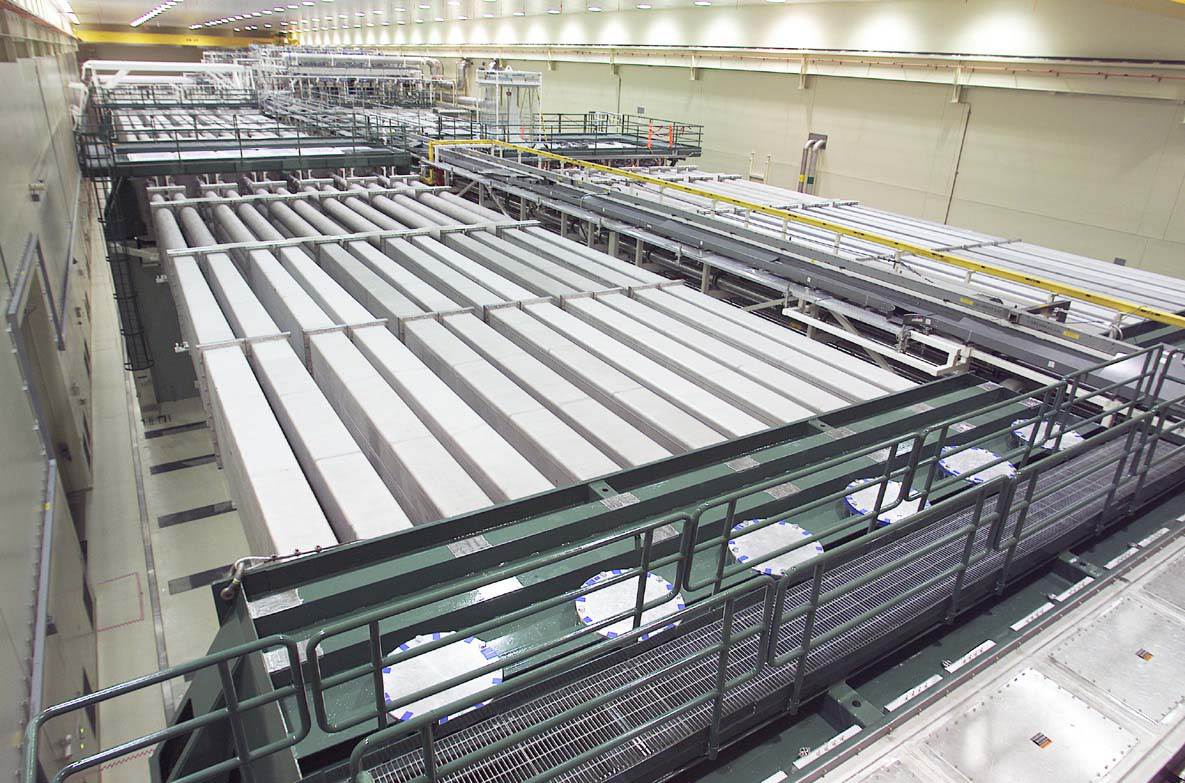
With their target completion date just a year and a half away, scientists and technicians at the National Ignition Facility (NIF) are quickening their pace to install and test the rest of NIF’s 192 lasers and prepare for a new round of preliminary experiments in 2008.
This is a report from Lawrence Livermore National Laboratory (LLNL) official web site:
Ninety-six NIF beamlines have been fired together for the first time, with “excellent” control system and laser stability, according to NIF & Photon Science Principal Associate Director Ed Moses. Last month the facility’s injection laser systems, which initiate the laser pulses, were fired for 144 beamlines.
“A total infrared energy of more than 2.5 megajoules has now been fired,” Moses said. “This is more than 40 times what the Nova laser (NIF’s predecessor) typically operated at the time it was the world's largest laser.”
 The first of the facility’s two 96-beam laser bays was commissioned at the end of July. Each of the 96 beams fired an infrared output energy of about 22,000 joules, more than enough to meet NIF’s operational and performance requirements. Since then six more eight-beam “bundles” are being commissioned in the second laser bay, and three of these bundles have been operationally qualified.
Overall commissioning of the NIF beamlines is scheduled for 2009.
The laser shots last about 25 billionths of a second, a tiny fraction of the time it takes to blink an eye. Firing the beams requires operation of 2,300 high-quality optics and instrumentation modules and nearly 400 computers running a million lines of control system code.
The tests measure the quality of each beam’s spatial profile and temporal pulse shape. Even though each shot is exceedingly short in time, its energy output and frequency is designed to vary significantly throughout its duration depending on the type of experiments being conducted.
Meanwhile, data gathered from experiments conducted at NIF in 2003-2004 have enabled sophisticated computer simulations that confirm NIF’s ability to reach the energy levels and beam quality required to produce the world’s first demonstration of inertial confinement fusion.
The “NIF Early Light” experiments included four shots using four laser beams at high energy on a full-scale target for the first time. Simulations of the experiments on LLNL’s world-class supercomputers matched the actual experimental data to an unprecedented degree. The experiments and simulations indicate that NIF’s laser beams will propagate effectively in plasma-filled targets designed to achieve fusion ignition and thermonuclear burn.
NIF experiments next year will focus 96 beams on a gold hohlraum (the eraser-sized capsule containing the fusion target) filled with a light gas mixture. Dubbed “Eos” for the Greek goddess of dawn, the experiments will use the first set of beams from the completed laser bay, traveling to the center of the ten-meter diameter target chamber. They are designed to help validate key aspects of the full-scale ignition campaign that begins in 2010.
This is a report from Lawrence Livermore National Laboratory (LLNL) official web site:
Ninety-six NIF beamlines have been fired together for the first time, with “excellent” control system and laser stability, according to NIF & Photon Science Principal Associate Director Ed Moses. Last month the facility’s injection laser systems, which initiate the laser pulses, were fired for 144 beamlines.
“A total infrared energy of more than 2.5 megajoules has now been fired,” Moses said. “This is more than 40 times what the Nova laser (NIF’s predecessor) typically operated at the time it was the world's largest laser.”
 The first of the facility’s two 96-beam laser bays was commissioned at the end of July. Each of the 96 beams fired an infrared output energy of about 22,000 joules, more than enough to meet NIF’s operational and performance requirements. Since then six more eight-beam “bundles” are being commissioned in the second laser bay, and three of these bundles have been operationally qualified.
Overall commissioning of the NIF beamlines is scheduled for 2009.
The laser shots last about 25 billionths of a second, a tiny fraction of the time it takes to blink an eye. Firing the beams requires operation of 2,300 high-quality optics and instrumentation modules and nearly 400 computers running a million lines of control system code.
The tests measure the quality of each beam’s spatial profile and temporal pulse shape. Even though each shot is exceedingly short in time, its energy output and frequency is designed to vary significantly throughout its duration depending on the type of experiments being conducted.
Meanwhile, data gathered from experiments conducted at NIF in 2003-2004 have enabled sophisticated computer simulations that confirm NIF’s ability to reach the energy levels and beam quality required to produce the world’s first demonstration of inertial confinement fusion.
The “NIF Early Light” experiments included four shots using four laser beams at high energy on a full-scale target for the first time. Simulations of the experiments on LLNL’s world-class supercomputers matched the actual experimental data to an unprecedented degree. The experiments and simulations indicate that NIF’s laser beams will propagate effectively in plasma-filled targets designed to achieve fusion ignition and thermonuclear burn.
NIF experiments next year will focus 96 beams on a gold hohlraum (the eraser-sized capsule containing the fusion target) filled with a light gas mixture. Dubbed “Eos” for the Greek goddess of dawn, the experiments will use the first set of beams from the completed laser bay, traveling to the center of the ten-meter diameter target chamber. They are designed to help validate key aspects of the full-scale ignition campaign that begins in 2010.
Thursday, November 29, 2007
Photonic crystal fiber produces ultrafast pulses
Reported from optic.org:
A new design of hollow-core photonic crystal fiber (HC PCF) has been developed by an international team led by Fetah Benabid of Bath University in the UK. One immediate result has been a method to produce attosecond laser pulses more efficiently than previous techniques.
 The fiber's unique properties have led directly to a second breakthrough, the efficient generation of a broad spectrum of ultrafast pulses from a hydrogen-filled PCF through stimulated Raman scattering.
The conventional technique to create attosecond pulses is high-harmonic generation (HHG), which produces central wavelengths in the XUV or soft X-ray region through the firing of a very intense laser pump pulse into a gas. Benabid's fiber was able to produce ultrashort pulses more simply using through stimulated Raman scattering. Benabid's fiber is claimed to require a pump pulse with power levels six orders of magnitude lower and five orders of magnitude longer than those previously needed for HHG.
A new design of hollow-core photonic crystal fiber (HC PCF) has been developed by an international team led by Fetah Benabid of Bath University in the UK. One immediate result has been a method to produce attosecond laser pulses more efficiently than previous techniques.
 The fiber's unique properties have led directly to a second breakthrough, the efficient generation of a broad spectrum of ultrafast pulses from a hydrogen-filled PCF through stimulated Raman scattering.
The conventional technique to create attosecond pulses is high-harmonic generation (HHG), which produces central wavelengths in the XUV or soft X-ray region through the firing of a very intense laser pump pulse into a gas. Benabid's fiber was able to produce ultrashort pulses more simply using through stimulated Raman scattering. Benabid's fiber is claimed to require a pump pulse with power levels six orders of magnitude lower and five orders of magnitude longer than those previously needed for HHG.
Monday, October 29, 2007
Surface heating of wire plasmas using laser-irradiated cone geometries
It's reported on the recent issue of Nature Physics.
Petawatt lasers can generate extreme states of matter, making them unique tools for high-energy-density physics. Pressures in the gigabar regime can potentially be generated with cone-wire targets when the coupling efficiency is high and temperatures reach 2–4 keV. The only other method of obtaining such gigantic pressures is to use the megajoule laser facilities being constructed (National Ignition Facility and Laser MégaJoule). The energy can be transported over surprisingly long distances but, until now, the guiding mechanism has remained unclear. Here, we present the first definitive experimental proof that the heating is maximized close to the wire surface, by comparison of interferometric measurements with hydrodynamic simulations. New hybrid particle-in-cell simulations show the complex field structures for the first time, including a reversal of the magnetic field on the inside of the wire. This increases the return current in a spatially separated thin layer below the wire surface, resulting in the enhanced level of ohmic heating. There are a significant number of applications in high-energy-density science, ranging from equation-of-state studies to bright, hard X-ray sources, that will benefit from this new understanding of energy transport.
LSP modelling of the azimuthal magnetic field structure at the cone tip, 600 fs after the main interaction. A reversed field can be seen on the inside of the wire surface corresponding to the ohmic return current, which is shown on the right picture.
Petawatt lasers can generate extreme states of matter, making them unique tools for high-energy-density physics. Pressures in the gigabar regime can potentially be generated with cone-wire targets when the coupling efficiency is high and temperatures reach 2–4 keV. The only other method of obtaining such gigantic pressures is to use the megajoule laser facilities being constructed (National Ignition Facility and Laser MégaJoule). The energy can be transported over surprisingly long distances but, until now, the guiding mechanism has remained unclear. Here, we present the first definitive experimental proof that the heating is maximized close to the wire surface, by comparison of interferometric measurements with hydrodynamic simulations. New hybrid particle-in-cell simulations show the complex field structures for the first time, including a reversal of the magnetic field on the inside of the wire.
 This increases the return current in a spatially separated thin layer below the wire surface, resulting in the enhanced level of ohmic heating. There are a significant number of applications in high-energy-density science, ranging from equation-of-state studies to bright, hard X-ray sources, that will benefit from this new understanding of energy transport.
LSP modelling of the azimuthal magnetic field structure at the cone tip, 600 fs after the main interaction. A reversed field can be seen on the inside of the wire surface corresponding to the ohmic return current, which is shown on the right picture.
Generation of intense continuum EUVradiation by many-cycle laser fields
The scientists at Institute of Electronic Structure & Laser in Greece and Max-Planck-Institut für Quantenoptik in Germany reported their research results in recent issue of Nature Physics.
Continuing efforts in ultrashort pulse engineering have recently led to the breakthroughs of the generation of attosecond (10^-18 s) pulse trains and isolated pulses. Although trains of multiple pulses can be generated through the interaction of many-optical-cycle pulses with gases—a process that has led to intense extreme-ultraviolet emission—the generation of isolated high-intensity pulses, which requires few-cycle driving pulses, remains a challenge. Here, we report a vital step towards the generation of such pulses, the production of broad continuum extreme-ultraviolet emission using a high-intensity, many-cycle, infrared pulsed laser, through the interferometric modulation of the ellipticity of 50-fs-long driving pulses. The increasing availability of high-power many-cycle lasers and their potential use in the construction of intense attosecond radiation—with either gas or solid-surface targets—offer exciting opportunities for multiphoton extreme-ultraviolet-pump–extreme-ultraviolet-probe studies of laser–matter and laser–plasma interactions.

The Dual Michelson interferometer device is shown in the left picture, BS: beam splitters. M: flat mirrors. TS1,2,3: piezoelectric translation stages. A: intensity attenuator. First and second MI: first and second Michelson interferometers.
Continuing efforts in ultrashort pulse engineering have recently led to the breakthroughs of the generation of attosecond (10^-18 s) pulse trains and isolated pulses. Although trains of multiple pulses can be generated through the interaction of many-optical-cycle pulses with gases—a process that has led to intense extreme-ultraviolet emission—the generation of isolated high-intensity pulses, which requires few-cycle driving pulses, remains a challenge. Here, we report a vital step towards the generation of such pulses, the production of broad continuum extreme-ultraviolet emission using a high-intensity, many-cycle, infrared pulsed laser, through the interferometric modulation of the ellipticity of 50-fs-long driving pulses. The increasing availability of high-power many-cycle lasers and their potential use in the construction of intense attosecond radiation—with either gas or solid-surface targets—offer exciting opportunities for multiphoton extreme-ultraviolet-pump–extreme-ultraviolet-probe studies of laser–matter and laser–plasma interactions.

The Dual Michelson interferometer device is shown in the left picture, BS: beam splitters. M: flat mirrors. TS1,2,3: piezoelectric translation stages. A: intensity attenuator. First and second MI: first and second Michelson interferometers.
Wednesday, October 17, 2007
Beam Homogenizer
A beam homogenizer is a device that smooths out the irregularities in a laser beam profile and creates a more uniform one. Most beam homogenizers use a multifaceted mirror with square facets. The mirror reflects light at different angles to create a beam with uniform power across the whole beam profile (a "top hat" profile).
The best results have been achieved with fly eye homogenizers which are composed of individually polished cylindrical lenses. The incoming laser beam is divided by an array of cylindrical lenses f_1 into several beamlets with size d. These beamlets match with the cylindrical lenses of a second array f_2. This second array and a condenser lens f_3 overlap all these beamlets in the focal plane of f_3. The homogenizer size D is proportional to the focal length of the collecting lens, the diameter and focal length of the micro-lens, and can be calculated using Equation:
D=(f_3/f_2)d
Interested Links:
Beam-shaping optics expand excimer-laser applications
How to Design a Gaussian to Top-Hat Beam Shaper
The best results have been achieved with fly eye homogenizers which are composed of
 individually polished cylindrical lenses. The incoming laser beam is divided by an array of cylindrical lenses f_1 into several beamlets with size d. These beamlets match with the cylindrical lenses of a second array f_2. This second array and a condenser lens f_3 overlap all these beamlets in the focal plane of f_3. The homogenizer size D is proportional to the focal length of the collecting lens, the diameter and focal length of the micro-lens, and can be calculated using Equation:
D=(f_3/f_2)d
Interested Links:
Beam-shaping optics expand excimer-laser applications
How to Design a Gaussian to Top-Hat Beam Shaper
Friday, October 05, 2007
Solar laser or solar energy laser?
Based on the news from Optics.org, Japanese team revives solar lasers in quest for clean fuels.
The idea of using solar energy to power lasers is not new. Current designs work by using a system of mirrors to concentrate sunlight into an Nd:YAG crystal, but these lasers are not widely used because they require huge mirrors to collect the light – and even then achieve only low efficiency.
 To address these issues, Takashi Yabe and colleagues at the Tokyo Institute of Technology experimented with using a Fresnel lens instead of mirrors as light collectors. They also found that doping the Nd:YAG crystal with small amounts of chromium significantly increases the power output of the laser.
The laser demonstrated by the team produces a power output of 24 W at 1064 nm. The design, which incorporates a 1.3 m2 Fresnel lens, offers an unprecedented slope efficiency of 12% above a threshold solar input of 500 W.
The idea of using solar energy to power lasers is not new. Current designs work by using a system of mirrors to concentrate sunlight into an Nd:YAG crystal, but these lasers are not widely used because they require huge mirrors to collect the light – and even then achieve only low efficiency.
 To address these issues, Takashi Yabe and colleagues at the Tokyo Institute of Technology experimented with using a Fresnel lens instead of mirrors as light collectors. They also found that doping the Nd:YAG crystal with small amounts of chromium significantly increases the power output of the laser.
The laser demonstrated by the team produces a power output of 24 W at 1064 nm. The design, which incorporates a 1.3 m2 Fresnel lens, offers an unprecedented slope efficiency of 12% above a threshold solar input of 500 W.
Tuesday, August 28, 2007
Compressor Alignment Procedure
I concentrated on the pulse compressor these days. Several motors were used to control two big 1200 line/mm gratings. The motors were controlled by Aerotech UNIDEX 511 motion controller. The computer interface program was written in LabView. It's easy to change the grating reflected angles and distances by rotating a hand wheel. The alignment procedure is:
1). Steering the mirrors to center the beam in the grating G1.
2). Set G1 to 0 degree to check the retro reflection.
3). Set G1 to Littrow angle (28.76 in our case) by adjusting the rock.
4). Change G1 to 13.358 for deviation.
5). Set G2 angle 26.716 for 0 degree back reflection checking.
6). Set G2 angle 55.48 for Littrow checking.
7). Set G1 and G2 both 13.358 degree.
related link: UNIDEX 511
1). Steering the mirrors to center the beam in the grating G1.
2). Set G1 to 0 degree to check the retro reflection.
3). Set G1 to Littrow angle (28.76 in our case) by adjusting the rock.
4). Change G1 to 13.358 for deviation.
5). Set G2 angle 26.716 for 0 degree back reflection checking.
6). Set G2 angle 55.48 for Littrow checking.
7). Set G1 and G2 both 13.358 degree.
related link: UNIDEX 511
Wednesday, August 22, 2007
Far-field distribution of the seed beam after 3rd ampfilfier
After checking the mirrors and cleaning the dirty ones, we measured the beam profile again. By changing the distance between convex lens and CCD camera, we can measure the far-field distribution of the seed beam. We believed the beam was still good after passing the third amplifier and many reflected mirrors.
 |  |
Monday, August 20, 2007
Measuring the seed beam profile after 3rd amplifier
 We measured the seed beam profile after third amplifier, the CCD camera was put behind the convex mirror of the telescope.
Because the camera was closed to the mirror, we measured the intensity distribution. From the picture shown in the right, we found there were some dust or damaged parts. We should check the optical path and optical components to find what caused this ugly beam profile.
Tuesday, August 14, 2007
YAG #4 beam alignment
 Before running the third amplifier, it's necessary to check pump laser beam qualities of YAG #3 and YAG #4. We found the some beam delivering mirrors for YAG #4 had been burned. Two mirrors were replaced by the new ones, the other two mirrors were just carefully rotated to avoid beam hit the small burned dots.
It's so excited that the spectrometer can be controlled by the desktop.
Thursday, August 09, 2007
Beam profile before the third amplifier
 After cleaning the delivering mirrors one by one, we measured the beam profile before inputing the third amplifier. This time, the beam looked similar to the Gaussian shape perfectly.
Femtosecond time-delay X-ray holography
Researchers have used the ultrafast X-ray pulses from a free-electron laser to image a nanoscale object in just a femtosecond. The technique, which is a new form of X-ray holography, has been pioneered by Henry Chapman from Lawrence Livermore National Laboratory and colleagues in the US, Switzerland and Germany. Being able to study materials so fast brings us one step closer to the holy grail of observing, at the same time, how all the atoms in a molecule move (Nature 448 676).
 The incident FEL pulse from the left passes through a hole in a multilayer-coated detector mirror. The 'dusty mirror' consists of particles on a 20-nm-thick silicon nitride membrane backed by a multilayer-coated plane mirror. This returns the direct beam back through the hole in the detector mirror, which reflects the diffracted light onto a CCD detector. The prompt diffraction (blue, the reference wave) and delayed diffraction (red, the object wave) interfere to generate the hologram on the CCD detector.
 The incident FEL pulse from the left passes through a hole in a multilayer-coated detector mirror. The 'dusty mirror' consists of particles on a 20-nm-thick silicon nitride membrane backed by a multilayer-coated plane mirror. This returns the direct beam back through the hole in the detector mirror, which reflects the diffracted light onto a CCD detector. The prompt diffraction (blue, the reference wave) and delayed diffraction (red, the object wave) interfere to generate the hologram on the CCD detector.
Wednesday, August 08, 2007
Realigning the laser pulse stretcher
 It's very hard to increase the output energy from the second amplifier, even optimizing the cavity more carefully. The problem might come from the front end, we traced the beam and found it's very weak after the stretcher. So it took time to realign the laser path and made the dim laser dot became very bright.
The first amplifier output energy without the saturater was around 5 mV (normally ~4 mV), it's about more than 2 mV with the saturater (normally ~1 mV). The output from second amplifier reached about 400 mV. The beam was delivered into the spatial filter and measured the profile using the CCD camera. The diffraction pattern indicated there was a dust or damage on some mirror surface.
Tuesday, August 07, 2007
Spectrum from laser osillator
 A loptop was used to replace the old desktop. In the beginning the spectrometer S2000-USB could not be recognized by the laptop. Somebody suggested to try another USB port, then the signal was appeared on the screen. This indicated the laptop remembered the original port connecting the hardware.
The snapshot of the spectra is shown on the right, the blue color line is reference spectrum, the red one is the real-time spectrum.
Thursday, August 02, 2007
The Control Computer Out of Order
I planed to run the whole system today, unfortunately I found the computer controlling the Ocean Optics S2000 spectrometer was down in the morning. I tried to restart the computer many times, it's no response. Because this spectrometer is used to monitor the laser spectrum, which can show if mode-locking status. The control computer must be repaired as soon as possible. The connection adapter is ADC1000-USB(S/N ADUD5565), the software is OOIBASE32.
The computer power supply was totally dead, I tried another computer. However it's not easy to run OOIBEASE32 in the new computer. I tried a laptop which the software has been install, but it cannot recognize the hardware.
The computer power supply was totally dead, I tried another computer. However it's not easy to run OOIBEASE32 in the new computer. I tried a laptop which the software has been install, but it cannot recognize the hardware.
Tuesday, July 31, 2007
Crystal surface burned again
 When the output energy after the PC2 became lower, I tried to tune the pump mirrors to maximize the output. During the tuning, I found the energy really became bigger, unfortunately the left side of the crystal was burned again. The similar phenomenon happened before, I think the measured energy was not the laser pulse but the spontaneous emission. When ASE goes higher, the pump beam was focused smaller, which would damage the crystal surface. Next tuning time, it's better to measure the pulse shape using the diode and make sure no ASE anymore.
I also found the Ti:sapphire crystal was not installed well, I put more Indium layer to hold the crystal tightly. Then I realigned the amplifier #1, changed the times of optical pass from 6 to 7.
Monday, July 30, 2007
Creating the pinhole for the spatial filter
I optimized the amplifier #2 alignment and obtained the normal output energy. Then the beam was delivered into the spatial filter. We already installed a piece of window for burning the pinhole last week. The seed beam from oscillator was blocked, so the ASE beam from first and second amplifiers was used to burn the hole. After about one and half hours, the beam could be watched from the spatial filter other side. The beam profile looked good by eyes, the real profile should be measured using the SPIRICON LBA camera.
Wednesday, July 25, 2007
YAG #1 and YAG #2 delivering mirrors burned
The amplifier #2 worked well, the next step is to send the beam to the spatial filter, before that we must drill a pinhole using the laser beam. We chose a piece of used window to replace the old window with a bad pinhole. We tried to use ASE from Amplifier #2 to burn the pinhole, due to its low energy, it will take more than 2 hours to do it. So we left the laser running, however, after half an hour, we found there was no light emission. Checking the 532nm reflected mirrors one by one, we found two of them were burned. After changing them, it took one more day to realign the first amplifier. So far we already got the cleaning pulse from the amplifier #1, but the output energy is very low. We need time to optimize this multi-pass amplifier and then test the amplifier #2 and drill the pinhole.
Monday, July 23, 2007
Measuring the AMP2 beam profile
 In order to measure the beam profile after the amplifier #2, we flip up the flip #3 before the mirror M16 ( see setup schematics ) to send the laser beam into a wedge. The laser beam was splitted by the wedge, and small part of laser beam was delivered into a SPRICON LBA-PC laser beam analyzer for diagnostics.
 The beam profile, as shown in the right picture, looked very ugly. The diffraction patten implied the Ti:sapphire crystal or the reflected mirror was somehow damaged. After carefully observation, we found the crystal surface has been burnt two spots. Some anti-reflection coating areas probably were stripped by the strong pump laser.
So we replaced the damaged crystal with a new one, the measured beam profile was shown in the left picture. The light distribution looked homogeneous, no any diffraction was found.
Wednesday, July 18, 2007
Beam delivering mirrors were damaged again
 After replacing the Ti:sapphire crystal of the first amplifier, we tested the CPA part 1 and part 2 this week. The output energies measured from test points were perfectly achieved what we expected. The crystal was not burned anymore after running 3 days, the output energy after first amplifier kept very stable from morning to the end of the work day. Unfortunately we found the surface of the beam delivering mirrors M18 and M19 was burned several dots. It's better to find what caused this damage before we change the mirrors. So we try to send the beam to the CCD camera to check the beam profile next week.
Monday, July 09, 2007
Why femtosecond lasers are not be used widely in industry?
In principle, femtosecond lasers provide a solution for most of micromachining, such as machining Teflon or glasses. The extremely high peak power means that nonlinear effects allow strong absorption even in transparent materials, enabling difficult materials to be machined. At the same time the very short pulses avoid thermal damage.
Unfortunately, femtosecond lasers have significant disadvantages. To date, most femtosecond lasers give high pulse energies at comparatively low repetition rates. The extremely high peak power tends to create a plasma at focus. The fireball is comparatively long-lived and significant thermal damage can result from the long-lived plasma. If the pulse energy is reduced to eliminate these effects, the material removal rate becomes extremely slow. Femtosecond lasers also tend to be complex, expensive, and high maintenance, making them unattractive for industrial use except where they are the only solution and the user fully understands their limitations. Therefore, while femtosecond systems are valuable research tools, they are not widely used in industry.
Digested Laser Focus World Vol. 43 (June, 2007)
Unfortunately, femtosecond lasers have significant disadvantages. To date, most femtosecond lasers give high pulse energies at comparatively low repetition rates. The extremely high peak power tends to create a plasma at focus. The fireball is comparatively long-lived and significant thermal damage can result from the long-lived plasma. If the pulse energy is reduced to eliminate these effects, the material removal rate becomes extremely slow. Femtosecond lasers also tend to be complex, expensive, and high maintenance, making them unattractive for industrial use except where they are the only solution and the user fully understands their limitations. Therefore, while femtosecond systems are valuable research tools, they are not widely used in industry.
Digested Laser Focus World Vol. 43 (June, 2007)
Wednesday, June 20, 2007
Plasma mirrors generate high harmonics
For many researchers working with high-intensity lasers, plasma formation is often bad news. For others, it’s an enabling step for putting their laser systems to good use, in the form of so-called plasma mirrors. Now, collaborators at CEN Saclay (Gif-sur-Yvette, France), École Polytechnique (Palaiseau, France), and the University of Toronto (Toronto, Ont., Canada) have used a chain of plasma mirrors to create extreme-ultraviolet (EUV) pulses that they predict to be on the attosecond timescale, all with a tabletop laser.
In the highest intensity femtosecond-laser systems, a nanosecond-scale prepulse can be enough to ablate the surface of samples before most of the pulse energy arrives. Enter the plasma mirror, a simple but effective solution to increase the contrast between the prepulse and the main pulse. By placing a highly polished mirror blank in the beam at Brewster’s angle, the nanosecond-scale prepulse passes unchanged. The rising edge of the main pulse, however, converts the surface of the mirror into a highly reflective plasma, specularly reflecting only the main pulse. Once the prepulse is cleaned up by two plasma mirrors, a third forms the basis for high-order harmonic generation (HHG).
C. Thaury et al.,Nature Phys. doi:10.1038/nphys595 (2007).
In the highest intensity femtosecond-laser systems, a nanosecond-scale prepulse can be enough to ablate the surface of samples before most of the pulse energy arrives. Enter the plasma mirror, a simple but effective solution to increase the contrast between the prepulse and the main pulse. By placing a highly polished mirror blank in the beam at Brewster’s angle, the nanosecond-scale prepulse passes unchanged. The rising edge of the main pulse, however, converts the surface of the mirror into a highly reflective plasma, specularly reflecting only the main pulse. Once the prepulse is cleaned up by two plasma mirrors, a third forms the basis for high-order harmonic generation (HHG).
C. Thaury et al.,Nature Phys. doi:10.1038/nphys595 (2007).
Tuesday, June 12, 2007
Laser vision fuels energy future
Photonics.com reported:
 The proposed European High Power laser Energy Research (HiPER) facility -- a device intended to demonstrate the feasibility of laser-driven fusion as an energy source -- is entering the preparation phase after completion of a two-year study by an international team of scientists.
Their conclusions have allowed the HiPER project to be selected as part of the European roadmap for future large-scale science facilities. The preparatory phase of the HiPER facility is expected to begin in January and to last for three years.
Achieving nuclear fusion using lasers is the goal of the National Ignition Facility, the latest in a series of high-power laser facilities used for research in inertial confinement fusion. Now under construction at the Lawrence Livermore National Laboratory, in Livermore, Calif., NIF is being built by the US Department of Energy as part of its Stockpile Stewardship program, and as such has a strong defense mission. "This is largely due to the fact that NIF converts its laser light to x-rays, and those x-rays are then used to implode the pellet (or perform other, classified experiments)," Dunne said. "This is meant to be analogous to the use of x-rays in thermonuclear weapons."
HiPER removes this link to defense science, Dunne said. "It uses the optical laser light directly to drive the implosion and initiate fusion. The physics associated with the interactions of lasers with matter have no relevance whatsoever to nuclear weapons, so we see this as very much a 'swords into ploughshares' undertaking."
For more information, visit: www.hiper-laser.org
 The proposed European High Power laser Energy Research (HiPER) facility -- a device intended to demonstrate the feasibility of laser-driven fusion as an energy source -- is entering the preparation phase after completion of a two-year study by an international team of scientists.
Their conclusions have allowed the HiPER project to be selected as part of the European roadmap for future large-scale science facilities. The preparatory phase of the HiPER facility is expected to begin in January and to last for three years.
Achieving nuclear fusion using lasers is the goal of the National Ignition Facility, the latest in a series of high-power laser facilities used for research in inertial confinement fusion. Now under construction at the Lawrence Livermore National Laboratory, in Livermore, Calif., NIF is being built by the US Department of Energy as part of its Stockpile Stewardship program, and as such has a strong defense mission. "This is largely due to the fact that NIF converts its laser light to x-rays, and those x-rays are then used to implode the pellet (or perform other, classified experiments)," Dunne said. "This is meant to be analogous to the use of x-rays in thermonuclear weapons."
HiPER removes this link to defense science, Dunne said. "It uses the optical laser light directly to drive the implosion and initiate fusion. The physics associated with the interactions of lasers with matter have no relevance whatsoever to nuclear weapons, so we see this as very much a 'swords into ploughshares' undertaking."
| Laser Fusion Facilities | ||||
|---|---|---|---|---|
| LASER FACILITY | LOCATION | COMPRESSION ENERGY | IGNITION POWER | ESTIMATED START |
| National Ignition Facility | United States | 1.8 MJ | NA | 2009 |
| Laser Mégajoule | France | 2.0 MJ | NA | 2011 |
| FIREX-I + Gekko XII | Japan | 10 kJ | 1 PW (10 kJ) | 2007 |
| OMEGA EP | United States | 30 kJ | 2 PW (5 kJ) | 2007 |
| HiPER | Europe | 200 kJ | 10 PW (70 kJ) | proposed |
For more information, visit: www.hiper-laser.org
Thursday, June 07, 2007
Relativistic tennis with photons
Science daily news reported that a team from Advanced Photon Research Center at the Japan Atomic Energy Agency has demonstrated to generate an ultrashort and ultraintense x-ray pulse using the ordinary laser.
 Sergei Bulanov of the Advanced Photon Research Center at the Japan Atomic Energy Agency in Kyoto and colleagues say they have a prototype that can generate pulses of x-ray laser light on the cheap. The researchers call their technique "relativistic tennis with photons," but a more violent analogy may better convey how it works. Suppose you throw a golf ball at a locomotive that is speeding toward you. The golf ball will bounce off it and come flying back at you with tremendous energy--just before you get run over.
The golf ball is a pulse of ordinary low-energy photons. With a tabletop setup, Bulanov and colleagues create the equivalent of a locomotive by firing a different laser into a cloud of plasma, where it creates a wake that travels at near-light speed. When the photons hit the wake, their energy increases 56-fold. They are also focused into an ultrashort, ultraintense blast by the wake, which is shaped like a miniature radar dish.
 Sergei Bulanov of the Advanced Photon Research Center at the Japan Atomic Energy Agency in Kyoto and colleagues say they have a prototype that can generate pulses of x-ray laser light on the cheap. The researchers call their technique "relativistic tennis with photons," but a more violent analogy may better convey how it works. Suppose you throw a golf ball at a locomotive that is speeding toward you. The golf ball will bounce off it and come flying back at you with tremendous energy--just before you get run over.
The golf ball is a pulse of ordinary low-energy photons. With a tabletop setup, Bulanov and colleagues create the equivalent of a locomotive by firing a different laser into a cloud of plasma, where it creates a wake that travels at near-light speed. When the photons hit the wake, their energy increases 56-fold. They are also focused into an ultrashort, ultraintense blast by the wake, which is shaped like a miniature radar dish.
Wednesday, June 06, 2007
Improvement of the multipass amplifier
In order to protect the crystal, we tried many ways including decreasing the pump energy, walking away the focal point from crystal, reflecting back the pump beam, however the crystal still was burned sometimes. So this time we try to using the second beam to pump from the other side. The second was sent to dump before, now we added three mirrors to steer the beam into the crystal.
Tuesday, June 05, 2007
A good overview of plasma wakefield
Dr. Chan Joshi, the professor of University of California, Los Angeles, reviews recent progress in the development of plasma-based particle accelerators and considers the challenges still to be overcome to turn this concept into a practical technology for high-energy physics. This overview was published on recent CERN Courier Vol 47, No.5(2007).

(a) A simple 1D schematic of how wakefields are excited by a short-laser (top) or particle-beam (bottom) driver in a plasma. (b) 3D computer simulation of an extremely nonlinear wakefield excited by the drive beam in the "bubble" regime. The wakefield can accelerate an appropriately phased trailing beam at ultra-high gradients.

Monday, June 04, 2007
Who first observed the ponderomotive force?
In research field of high intensity laser, the ponderomotive force is the important concept. Most of us got the description from Kruer's book, in fact this phenomena was obtained at first time in 1957. From web site of Nature Physics looking back, it tells us:
In 1957, Boot and Harvie reported the observation of a force on charged particles in an inhomogeneous electric field, which originated from second-order terms of the equation for the Lorentz force on the particles. Almost immediately it was realized that this 'ponderomotive force' could be used to trap and control electrons. But the force is weak: only with the development of modern laser technology is the ponderomotive force being exploited in new particle-acceleration techniques and inertial confinement fusion.
Nature 180, 1187 (1957)
In 1957, Boot and Harvie reported the observation of a force on charged particles in an inhomogeneous electric field, which originated from second-order terms of the equation for the Lorentz force on the particles. Almost immediately it was realized that this 'ponderomotive force' could be used to trap and control electrons. But the force is weak: only with the development of modern laser technology is the ponderomotive force being exploited in new particle-acceleration techniques and inertial confinement fusion.
Nature 180, 1187 (1957)
Thursday, May 24, 2007
Laser-generated radiation for cancer therapy?
Will laser-generated radiation one day prove useful in cancer therapy? A UK collaboration aims to find out. Reported from oprtics.org:
 A consortium of UK-based scientists has secured £5 million ($9.9 million) in research funding to turn the concept of laser-generated radiation into a robust, ready-to-go technology. The four-year project, involving researchers from nine separate institutions, could lead to cheaper, simpler solutions for proton and ion radiotherapy. Laser-energized radiation sources could also cut the cost of research into cosmic-radiation exposure from frequent air travel and manned space missions.
The project named LIBRA, which means Laser Induced Beams of Radiation and their Applications. Development of the technology will require access to a very high-powered laser with a rapid-fire repetition rate. One such system is the GEMINI laser, due to come on-line at the Rutherford Appleton Laboratory (RAL) near Oxford, UK, later this year. GEMINI is expected to deliver 1 PW (10^15 W) pulses every 20 seconds.
related links: LIBRA, GEMINI
 A consortium of UK-based scientists has secured £5 million ($9.9 million) in research funding to turn the concept of laser-generated radiation into a robust, ready-to-go technology. The four-year project, involving researchers from nine separate institutions, could lead to cheaper, simpler solutions for proton and ion radiotherapy. Laser-energized radiation sources could also cut the cost of research into cosmic-radiation exposure from frequent air travel and manned space missions.
The project named LIBRA, which means Laser Induced Beams of Radiation and their Applications. Development of the technology will require access to a very high-powered laser with a rapid-fire repetition rate. One such system is the GEMINI laser, due to come on-line at the Rutherford Appleton Laboratory (RAL) near Oxford, UK, later this year. GEMINI is expected to deliver 1 PW (10^15 W) pulses every 20 seconds.
related links: LIBRA, GEMINI
Thursday, May 17, 2007
Maintaining the cooling system for Quanta Ray - PRO
 Quanta Ray lasers YAG #3 and YAG #4 could not be started, the fault signals were shown on their monitors. The possible reason is that the deionized water has not been circulated for a long time, the best way is to change the filters and refill the fresh water. We drained the water from YAG #3, and filled the vinegar for flushing the cooling system.
Wednesday, May 09, 2007
Theodore Maiman -- Laser Inventor Dies at 79
 Theodore Maiman, PhD, inventor of the first operable laser and twice nominated for a Nobel Prize, died May 5 in Vancouver, British Columbia. His death was confirmed by his wife, Kathleen.
He had been called “the father of the electro-optics industry,” according to a biography at the IEEE virtual Museum, but Maiman considered himself "a scientist and an engineer, with research interests in electro-optics, lasers, displays and aerodynamics."
Source: Photonics.com
Monday, May 07, 2007
Low Evolution X output power
The Evolution -- the DPSS Q-switched green laser is used to pump the Ti:sapphire crystal for regeneration amplifier of 30 fs laser pulses. However its output power was dropped dramatically when we operated it this morning. The power could not be changed very much when we tuned two cavity mirrors. Later we adjusted the diodes temperature between 80F and 83F, the power just fluctuated from 22mW to 18mV when the output was set at 23%. In the normal way, the power should be around 600mW.
Friday, May 04, 2007
Ultrashort laser pulse around 100 attoseconds
Working at Italy's National Laboratory for Ultrafast and Ultraintense Optical Science in Milan (as well as laboratories in Padua and Naples), the researchers believe that their current technique will allow them to create even shorter pulses well below 100 attoseconds. Results will be presented in Baltimore at CLEO/QELS, May 6 – May 11.
Creating a single isolated attosecond pulse, rather than a train of them, is more complex. To do this, the researchers employ their previously developed technique for delivering intense short (5 femtoseconds, or millionths of a billionth of a second) laser pulses to an argon gas target. They use additional optical techniques (including ones borrowed from the research that won the 2005 Nobel Prize in Physics) for creating and shaping a single attosecond pulse. Light pulses lasting just 130 attoseconds offer possibilities for unlocking secrets of atoms and molecules.
Related Link: National Laboratory for Ultrafast and Ultraintense Optical Science
Source: PhysOrg.com
Creating a single isolated attosecond pulse, rather than a train of them, is more complex. To do this, the researchers employ their previously developed technique for delivering intense short (5 femtoseconds, or millionths of a billionth of a second) laser pulses to an argon gas target. They use additional optical techniques (including ones borrowed from the research that won the 2005 Nobel Prize in Physics) for creating and shaping a single attosecond pulse. Light pulses lasting just 130 attoseconds offer possibilities for unlocking secrets of atoms and molecules.
Related Link: National Laboratory for Ultrafast and Ultraintense Optical Science
Source: PhysOrg.com
Friday, April 27, 2007
VORPAL: Versatile Plasma Simulation Code
VORPAL enables researchers to simulate complex physical phenomena in less time and at a much lower cost than empirically testing process changes for plasma and vapor deposition processes. VORPAL offers a unique combination of physical models to cover the entire range of plasma simulation problems. Laser wakefield accelerators, plasma thrusters, high-power microwave guides, and plasma processing chambers are only a few of the many applications benefiting from the powerful, parallel algorithms incorporated into the VORPAL framework. Ionization and neutral gas models enable VORPAL to bridge the gap between plasma and neutral flow physics. The software runs on a wide range of computing platforms, from desktop machines to massively parallel supercomputers with thousands of processors. The use of standard data formats allows data analysis at various levels of sophistication, including your own preferred data analysis tool.
Source: Tech-X Corporation
Source: Tech-X Corporation
Friday, April 20, 2007
Dr. Eric Cornell: Searching for the Electron's Electric Dipole Moment in Trapped Molecular Ions
I joined the Physics Division Colloquium at Argonne this morning. Dr. Eric Cornell, 2001 Nobel Prize winner presented a great talking about his resent research on electron electric dipole moment (eEDM).
Searching for the Electron's Electric Dipole Moment in Trapped Molecular Ions
 The current experimental upper bound on the electron electric dipole moment (eEDM) already cuts into the natural scale predicted by supersymmetry. I'll discuss an ongoing experiment in our lab to push experimental sensitivity down some two orders of magnitude. The effective electric fields inside a molecule can be thousands of times larger than in free space. A molecule with unpaired electron spin serves as our high-field lab for this benchtop particle physics experiment.
related link: Cornell Group
Searching for the Electron's Electric Dipole Moment in Trapped Molecular Ions
 The current experimental upper bound on the electron electric dipole moment (eEDM) already cuts into the natural scale predicted by supersymmetry. I'll discuss an ongoing experiment in our lab to push experimental sensitivity down some two orders of magnitude. The effective electric fields inside a molecule can be thousands of times larger than in free space. A molecule with unpaired electron spin serves as our high-field lab for this benchtop particle physics experiment.
related link: Cornell Group
Thursday, April 19, 2007
The crystal melting movie?
As Phy Org web reported, Stanford Synchrotron Radiation Laboratory (SSRL) researchers
have observed the atomic events involved in rapid crystal melting using an intense laser and ultra-fast x-rays.
 Sub-Picosecond Pulse Source (SPPS) provides short bursts of x-rays (2 x 10^6 photons in an 80 fs FWHM pulse at 8.9 keV with a 1.5% bandwidth into a 200 um by 400 um spot). The laser pulse (50fs FWHM, 20 mJ @ 800 nm) at the sample, which convolved with the x-ray pulse yields a Gaussian cross correlation of 100 fs FWHM.
The data, published recently in Physical Review Letters, revealed that when their bonds destabilized, the atoms moved apart from each other quickly, as if repelling each other. The semiconductor material had visible melting damage after being struck by the laser.
have observed the atomic events involved in rapid crystal melting using an intense laser and ultra-fast x-rays.
 Sub-Picosecond Pulse Source (SPPS) provides short bursts of x-rays (2 x 10^6 photons in an 80 fs FWHM pulse at 8.9 keV with a 1.5% bandwidth into a 200 um by 400 um spot). The laser pulse (50fs FWHM, 20 mJ @ 800 nm) at the sample, which convolved with the x-ray pulse yields a Gaussian cross correlation of 100 fs FWHM.
The data, published recently in Physical Review Letters, revealed that when their bonds destabilized, the atoms moved apart from each other quickly, as if repelling each other. The semiconductor material had visible melting damage after being struck by the laser.
Thursday, April 12, 2007
A 32TW laser beam sending into the atmosphere
 Recent paper published on APL reported the ultrahigh power laser pulses have been sent vertically into the atmosphere. Scientists from Switzerland and France sent 26J, 32TW laser pulses delivered by the Alise beamline of the CEA-CESTA into the sky. They found more than 400 self-guided filaments. The white light was observed when the laser beam propagating up to the air, beyond 20km.
If you are interested this phenomena, you may download the full text paper from the APL website.
Tuesday, April 03, 2007
EUV Tool Produces Images
This was just announced today on Photonics web.
The $65 million EUV ADT, developed by Netherlands-based ASML Holding NV, a supplier of advanced lithography tools, will be essential in development of the infrastructure for EUV lithography and is considered the most likely technology for insertion into manufacturing as early as the 32-nm computer chip device node, based on cost-effectiveness and ability to extend to future nodes, according to ASML.
I am very courious about this EUV source, how can they produce a 32 nm laser for lithography? There is no answer from the Photonicsweb report. I did not get answer from College of Nanoscale Science and Engineering at the University at Albany (UAlbany). Fortunately ASML tell us it's the plasma physics to produce this short wavelength:
The light source for EUV is a gas through which a high-voltage electrical charge (or high energy photons) is sent. This ionizes the gas, separating the nucleus of the atoms from the electrons, thereby creating a plasma, a very hot cloud of ions. As the electrons attempt to return to the nucleus, they emit a burst of light, which has a very short wavelength of 13.5 nm.
For more information visit: EUV Lithography: The next generation
The $65 million EUV ADT, developed by Netherlands-based ASML Holding NV, a supplier of advanced lithography tools, will be essential in development of the infrastructure for EUV lithography and is considered the most likely technology for insertion into manufacturing as early as the 32-nm computer chip device node, based on cost-effectiveness and ability to extend to future nodes, according to ASML.
I am very courious about this EUV source, how can they produce a 32 nm laser for lithography? There is no answer from the Photonicsweb report. I did not get answer from College of Nanoscale Science and Engineering at the University at Albany (UAlbany). Fortunately ASML tell us it's the plasma physics to produce this short wavelength:
The light source for EUV is a gas through which a high-voltage electrical charge (or high energy photons) is sent. This ionizes the gas, separating the nucleus of the atoms from the electrons, thereby creating a plasma, a very hot cloud of ions. As the electrons attempt to return to the nucleus, they emit a burst of light, which has a very short wavelength of 13.5 nm.
For more information visit: EUV Lithography: The next generation
Wednesday, March 28, 2007
Please visit new blog -- Femtosecond KrF Excimer Laser
I applied blog space for Femtosecond KrF Excimer Laser system at UIC. This blog will concern about the ultrafast high field laser and its applications. Every UIC laser lab member can post in the new blog, the URL is http://uicexcimer.blogspot.com/.
Wednesday, March 21, 2007
What Is an Energy Recovery Linac (ERL)?
An Energy Recovery Linac (ERL) x-ray source is a candidate next-generation x-ray source technology now under active development. ERLs are made possible by recent advances in superconducting linear accelerators and in high-brightness electron sources. ERLs have the potential to generate synchrotron radiation with brightness about 1000 times greater than that of today's storage rings, resulting in highly coherent x-radiation. ERL's are particularly well suited for the production of very fast x-ray pulses to examine the dynamics of materials on extremely rapid time scales and for intense x-ray nanoprobe beams to study nanoscopic matter. While both ERLs and XFELS will be able to produce very fast x-ray pulses, the two sources are quite distinct in the timing of these pulses: ERLs are being designed to produce pulses times up to a billion times a second whereas XFELs produce bigger pulses but at a far lower rate per second.
 Image 1. Electrons are released from the injector at the lower left, and are accelerated in a long linear superconducting accelerator (main linac). After emerging from this linac, the electrons pass through undulators that wiggle the electron beam and produce the x-rays in the usual way. Electrons are continuously injected, make one trip around the ring, and return to the main linac where their energy is recovered. The spent beam is directed to the dump. (Courtesy: Cornell University)
 Image 1. Electrons are released from the injector at the lower left, and are accelerated in a long linear superconducting accelerator (main linac). After emerging from this linac, the electrons pass through undulators that wiggle the electron beam and produce the x-rays in the usual way. Electrons are continuously injected, make one trip around the ring, and return to the main linac where their energy is recovered. The spent beam is directed to the dump. (Courtesy: Cornell University)
Monday, March 05, 2007
PHOTONIC FRONTIERS: PETAWATT LASERS
Squeezing energetic laser pulses down to ultrashort durations can generate tremendous peak powers. A decade ago the Lawrence Livermore National Laboratory (LLNL; Livermore, CA) blazed the trail by modifying one arm of its Nova fusion laser to create the Petawatt Laser, which delivered pulses exceeding 1015 W (1 PW). Now some 20 petawatt lasers are in operation or development around the world, and European planners are aiming for an exowatt (1018 W) laser (see table).
Some major petawatt laser projects
The first petawatt laser
Livermore’s Petawatt Laser used a chain of Nd:glass lasers from one beam of the Nova fusion laser to amplify nanosecond pulses to the kilojoule range. Pulses were expanded and compressed with high-efficiency 75 cm gratings. Amplifier output of 1.3 kJ in an 800 ps pulse could be compressed down to a 430 fs pulse with peak power of 1.3 PW, which in turn could produce power density approaching 1021 W/cm2. The system generated its first petawatt pulse on May 23, 1996, and ran for three years until Nova was dissembled in 1999.
The Livermore experiments demonstrated the potential of petawatt lasers to concentrate tremendous energies into small volumes, opening a new regime of high-temperature and high-pressure matter for study. The intense fields could accelerate both electrons and positive ions to high velocities over short distances (see www.laserfocusworld.com/articles/252490). Experiments generated bright beams of high-energy x-rays and gamma rays. And Livermore also showed that firing petawatt lasers into a laser-heated fusion target produced a powerful shock wave that helped ignite the fusion fuel.
Second-generation petawatt lasers
The second generation of petawatt lasers is already operating. The Rutherford Appleton Laboratory (Didcot, England) uses a Ti:sapphire oscillator and an optical parametric amplifier to preamplify pulses which then pass through a beam of the lab’s Vulcan Nd:glass laser, and three additional 208 mm Nd:glass disks salvaged from Nova (see Fig. 2). Commissioned in 2002, it initially produced 800 fs pulses with peak power of 500 TW. Further refinements ramped up power, which reached the petawatt level in October 2004, delivering 423 J onto the target in a 410 fs pulse.
Livermore has built a second-generation petawatt laser called Titan around the old two-beam Janus Nd:glass laser used in fusion target experiments back in 1975, says Andrew Ng of Lawrence Livermore National Laboratory (LLNL). Overhauled with better glass, the system has two independent beam lines for chirped-pulse amplification and a new generation of pulse-compression gratings. The first experiments in June 2005 generated 400 J in 400 fs to reach petawatt peak power focusable onto an 8 µm spot. It also can operate in long-pulse mode, generating 1 kJ in less than 3 ns or 140 J in 250 ps. Titan can fire long and short pulses simultaneously from its two arms. Ng says that firing long pulses to create a plasma and short pulses to probe the plasma is a very effective way to study high-energy states.
Livermore is also planning a big step up in energy with a second long-pulse system for use with the National Ignition Facility. Called the Advanced Radiographic Capability, it initially will fire 1 kJ pulses to record multiframe x-ray movies of NIF targets, says lead scientist Chris Barty of LLNL. By combining four NIF beams, he hopes to generate 13.2 kJ in a 10 ps pulse. The first beamline is to be commissioned in spring 2009.
Most other systems in operation, construction, or planning stages are either long-pulse systems based on Nd:glass or Ti:sapphire systems generating pulses as short as 20 fs. The main exception is the $15 million Texas Petawatt Laser, which will use parametric amplification to raise the 1 J output of a Ti:sapphire oscillator to 250 J, which they hope to deliver in 150 fs pulses. Project director Todd Ditmire hopes to produce his first petawatt pulses late in 2007.
Laser Focus World August, 2006
Author: Jeff Hecht
Some major petawatt laser projects
| Name | Site | Timetable | Parameters | Web site Link |
|---|---|---|---|---|
| Advanced Radiographic Capability | Livermore | 2009 | 10 kJ, 10 ps | |
| Extreme Light Infrastructure | Laboratoire d’Optique Appliquée, France | Proposal | 10 kJ, 10 fs | ELI |
| Firex-1 | ILE, Osaka, Japan | Under construction | 10 kJ, 10 ps | |
| GEKKO Petawatt Module | ILE, Osaka, Japan | In operation | 500 J, 500 fs | |
| Laser Megajoule | University of Bordeaux | Proposal | 2 MJ, 300 ps-10 ns | lmj |
| LULI 2000 | LULI, Paris | Under construction; completion 2006 | 200 J, 400 fs | |
| Omega EP | University of Rochester | 2007 | 2.6 kJ, 1 ps | omegaep |
| Petawatt Laser (original) | Livermore | 1996-1999 | 1.3 kJ, 800 fs | MPerry |
| Phelix | GSI Darmstadt, Germany | Under construction, with heavy-ion beam | 500 J, <500 fs | phelix |
| Polaris | University of Jena, Germany | Development | 120 J, 120 fs | ultraphotonics |
| Texas Petawatt Laser | University of Texas, Austin | Late 2007 | 130 J, 150 fs | petawatt |
| Titan | Livermore | In operation | 400 J, 400 fs or long-pulse | JLF |
| Vulcan Petawatt | Rutherford Appleton Lab, UK | In operation | 400 J, 400 fs | vulcan |
| Z-beamlet | Sandia National Laboratory | Under construction | 2 kJ, 1-10 ps ultimately | z-beamlet |
The first petawatt laser
Livermore’s Petawatt Laser used a chain of Nd:glass lasers from one beam of the Nova fusion laser to amplify nanosecond pulses to the kilojoule range. Pulses were expanded and compressed with high-efficiency 75 cm gratings. Amplifier output of 1.3 kJ in an 800 ps pulse could be compressed down to a 430 fs pulse with peak power of 1.3 PW, which in turn could produce power density approaching 1021 W/cm2. The system generated its first petawatt pulse on May 23, 1996, and ran for three years until Nova was dissembled in 1999.
The Livermore experiments demonstrated the potential of petawatt lasers to concentrate tremendous energies into small volumes, opening a new regime of high-temperature and high-pressure matter for study. The intense fields could accelerate both electrons and positive ions to high velocities over short distances (see www.laserfocusworld.com/articles/252490). Experiments generated bright beams of high-energy x-rays and gamma rays. And Livermore also showed that firing petawatt lasers into a laser-heated fusion target produced a powerful shock wave that helped ignite the fusion fuel.
Second-generation petawatt lasers
The second generation of petawatt lasers is already operating. The Rutherford Appleton Laboratory (Didcot, England) uses a Ti:sapphire oscillator and an optical parametric amplifier to preamplify pulses which then pass through a beam of the lab’s Vulcan Nd:glass laser, and three additional 208 mm Nd:glass disks salvaged from Nova (see Fig. 2). Commissioned in 2002, it initially produced 800 fs pulses with peak power of 500 TW. Further refinements ramped up power, which reached the petawatt level in October 2004, delivering 423 J onto the target in a 410 fs pulse.
Livermore has built a second-generation petawatt laser called Titan around the old two-beam Janus Nd:glass laser used in fusion target experiments back in 1975, says Andrew Ng of Lawrence Livermore National Laboratory (LLNL). Overhauled with better glass, the system has two independent beam lines for chirped-pulse amplification and a new generation of pulse-compression gratings. The first experiments in June 2005 generated 400 J in 400 fs to reach petawatt peak power focusable onto an 8 µm spot. It also can operate in long-pulse mode, generating 1 kJ in less than 3 ns or 140 J in 250 ps. Titan can fire long and short pulses simultaneously from its two arms. Ng says that firing long pulses to create a plasma and short pulses to probe the plasma is a very effective way to study high-energy states.
Livermore is also planning a big step up in energy with a second long-pulse system for use with the National Ignition Facility. Called the Advanced Radiographic Capability, it initially will fire 1 kJ pulses to record multiframe x-ray movies of NIF targets, says lead scientist Chris Barty of LLNL. By combining four NIF beams, he hopes to generate 13.2 kJ in a 10 ps pulse. The first beamline is to be commissioned in spring 2009.
Most other systems in operation, construction, or planning stages are either long-pulse systems based on Nd:glass or Ti:sapphire systems generating pulses as short as 20 fs. The main exception is the $15 million Texas Petawatt Laser, which will use parametric amplification to raise the 1 J output of a Ti:sapphire oscillator to 250 J, which they hope to deliver in 150 fs pulses. Project director Todd Ditmire hopes to produce his first petawatt pulses late in 2007.
Laser Focus World August, 2006
Author: Jeff Hecht
Monday, February 26, 2007
Counterpropagating light opens door to tabletop X-ray laser
 A team of researchers at the University of Colorado at Boulder has developed a new technique to generate laser-like X-ray beams, removing a major obstacle in the decades-long quest to build a tabletop X-ray laser that could be used for biological and medical imaging.
A paper on the subject by Murnane and Kapteyn, CU-Boulder graduate students Xiaoshi Zhang, Amy Lytle, Tenio Popmintchev, Xibin Zhou and Senior Research Associate Oren Cohen of JILA was published in the online version of the journal Nature Physics on Feb. 25.
Source: University of Colorado at Boulder
Wednesday, February 21, 2007
Terawatt Ultrafast High Field Facility: TUHFF
 The Chemistry Division’s Terawatt Ultrafast High Field Facility (TUHFF) was built in order to provide a source of femtosecond electron pulses, femtosecond tunable x-rays (soft and hard), and femtosecond proton pulses. TUHFF will primarily be used for applications in the fields of chemistry and physics. A Titanium:Sapphire based laser system that produces 0.6 Joules of energy in a 50 femtosecond pulse was constructed. This system produces peak powers in excess of 10 terawatt! Because of these extremely high power levels, part of the laser system and the experimental areas (target chamber) are contained in vacuum chambers to prevent the dielectric breakdown of air. Currently, we are exploring the generation of femtosecond pulses of ionizing radiation (both protons and electrons) and of x-rays by focusing this intense beam (power density >10^19 W/cm2!) into either a metal target (hard x-rays and protons) or a supersonic gas jet (energetic electrons).
Source: Chemistry division, Argonne National Laboratory
Monday, February 19, 2007
Extreme Light Lab installs near-petawatt system
 Laser science at the 100-terawatt (10^14 W) peak-power level has entered the commercial realm. An ultrafast Ti:sapphire laser system produced by Thales Laser (Orsay, France) and installed at the University of Nebraska, Lincoln (UNL; Lincoln, NE) reaches a 150 TW level and is upgradeable in the future to above the petawatt mark. Called Diocles, the laser, considered a fully commercial product, is enabling Donald Umdstadter’s group at UNL’s new Extreme Light Laboratory to perform day-to-day, stable, reproducible ultrafast experiments with an uptime much higher than that of pre-existing lasers of the same power scale. As such, it may usher in a new era of R&D with ultrapowerful lasers.
The Ti:sapphire oscillator is pumped with a continuous-wave green laser, the first amplifier is pumped with a 1 kHz diode-pumped Nd:YLF (yttrium lithium fluoride) frequency-doubled laser, and the three medium-to-high-power stages are pumped with 10 Hz frequency-doubled lamp-pumped Nd:YAG lasers. “The hybrid diode/lamp architecture is there to provide high beam quality and stability on the initial low-energy stages (diode pumped), and low-cost energy input for the high-energy stages (flashlamp pumped),” says Marquis. The pump lasers are all water-cooled via a water-water exchanger; the Ti:sapphire laser crystals are also water-cooled via a patent-pending technique that avoids the need for cryogenic cooling. The uncompressed output of the final amplifier exceeds 5 J at a 10 Hz pulse-repetition rate. The laser’s final output beam exceeds a Strehl ratio of 0.7.
Source: Laser Focus World
Wednesday, February 14, 2007
Plasma wakefield accelerator doubles particle energy in just one meter
Physicists in the US claim to have doubled the 42 GeV electron-beam energy of the three-kilometre-long Stanford Linear Accelerator Centre (SLAC) by simply adding a metre-long device on the end. The device, which uses a plasma wakefield to accelerate a small fraction of the electron beam, could allow conventional particle accelerators to reach higher energies (Nature 445 741).
 Plasma acceleration is a technique for accelerating charged particles, such as electrons, positrons and ions, using an electric field associated with an electron plasma wave. The wave is created by the passage of a very brief laser or electron pulse through the plasma. The technique appears to offer a way to build high performance particle accelerators of much smaller size than conventional devices at the expense of coherency. Current experimental devices show accelerating gradients several orders of magnitude better than current particle accelerators. For example, one experimental device at the Lawrence Berkeley National Laboratory accelerates electrons to 1 GeV over about 3.3 cm, whereas the SLAC conventional accelerator requires 64 m to reach the same energy. (Via Wikipedia)
 Plasma acceleration is a technique for accelerating charged particles, such as electrons, positrons and ions, using an electric field associated with an electron plasma wave. The wave is created by the passage of a very brief laser or electron pulse through the plasma. The technique appears to offer a way to build high performance particle accelerators of much smaller size than conventional devices at the expense of coherency. Current experimental devices show accelerating gradients several orders of magnitude better than current particle accelerators. For example, one experimental device at the Lawrence Berkeley National Laboratory accelerates electrons to 1 GeV over about 3.3 cm, whereas the SLAC conventional accelerator requires 64 m to reach the same energy. (Via Wikipedia)
Wednesday, January 31, 2007
Passivating the Protmehtes
Last week, we removed the Prometheus windows for cleaning. At the same time, we cleaned the 40168 spark gap at Rail Gap Trigger Unit. Unfortunately, the pipe fittings for spark gap were broken, we had to order them. This caused us to wait for about 2 days. Now everything is already, we are going to passivate the Prometheus. The operating voltage was about 14 kV for each bank, the passivation kept about 2 hours.
Subscribe to:
Posts (Atom)