In a paper accepted for publication in the American Institute of Physics' journal Review of Scientific Instruments,
a team of researchers describes an advanced experimental system that
can generate attosecond bursts of extreme ultraviolet light. Such pulses
are the shortest controllable light pulses available to science. With
these pulses, according to the researchers, it's possible to measure the
dynamics of electrons in matter in real-time. Advances in attosecond
science may enable scientists to verify theories that describe how
matter behaves at a fundamental level, how certain important chemical
reactions – such as photosynthesis – work. Additional advances may
eventually lead to the control of chemical reactions.
"Understanding how matter works at the level of its electrons is
likely to lead to new scientific tools and to novel technologies," said
Felix Frank, of Imperial College in London and one of the authors on the
paper. "In the future, this knowledge could help us to make better
drugs, more efficient solar cells, and other things we can't yet
foresee."
The researchers were able to produce these pulses by a process called
high harmonic generation (HHG). The fundamental technology driving
their setup is a high-power femtosecond laser system (femtoseconds are
three orders of magnitude longer than attoseconds). The near infrared
femtosecond laser pulses are corralled through a waveguide and a series
of specialized mirrors, causing them to be compressed in time. With
their waveforms precisely controlled, these compressed pulses are then
focused into a gas target, creating an attosecond burst of extreme
ultraviolet radiation. The experimental system developed by the
researchers is able to accurately measure the attosecond
pulses and deliver them to a variety of experiments in conjugation with
other precisely synchronized laser pulses. "Though it incorporates many
novel features, our system builds on a decade of research conducted by
physics groups around the world," said John Tisch, lead scientist
developing the technology at Imperial College.
Showing posts with label HHG. Show all posts
Showing posts with label HHG. Show all posts
Saturday, June 30, 2012


Friday, June 08, 2012
Tabletop laser-like device creates coherent multicolor beams of ultraviolet, T- and X-rays
For the first time, researchers have produced a coherent, laser-like, directed beam of light that simultaneously streams ultraviolet light, X-rays, and all wavelengths in between.
One of the few light sources to successfully produce a coherent beam that includes X-rays, this new technology is the first to do so using a setup that fits on a laboratory table.
An international team of researchers, led by engineers from the NSF Engineering Research Center (ERC) for EUV Science and Technology, reports their findings in the June 8, 2012, issue of Science.
By focusing intense pulses of infrared light--each just a few optical cycles in duration--into a high-pressure gas cell, the researchers converted part of the original laser energy into a coherent super-continuum of light that extends well into the X-ray region of the spectrum.
The X-ray burst that emerges has much shorter wavelengths than the original laser pulse, which will make it possible to follow the tiniest, fastest physical processes in nature, including the coupled dance of electrons and ions in molecules as they undergo chemical reactions, or the flow of charges and spins in materials.
"This is the broadest spectral-bandwidth, coherent-light source ever generated," says engineering and physics professor Henry Kapteyn of JILA at the University of Colorado at Boulder, who led the study with fellow JILA professor Margaret Murnane and research scientist Tenio Popmintchev, in collaboration with researchers from the Vienna University of Technology, Cornell University and the University of Salamanca.
"It definitely opens up the possibility to probe the shortest space and time scales relevant to any process in our natural world other than nuclear or fundamental particle interactions," Kapteyn adds. The breakthrough builds upon earlier discoveries from Murnane, Kapteyn and their colleagues to generate laser-like beams of light across a broad spectrum of wavelengths.
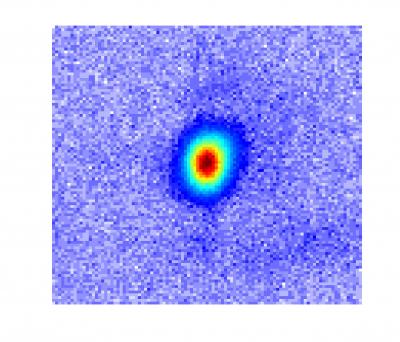 |
| This picture shows an actual image of a coherent (laser-like) X-ray beam. In contrast to the incoherent (light-bulb-like) light emitted in all directions from a Roentgen X-ray tube, the X-rays produced by high harmonic generation emerge as well-directed, laser-like, beams. |
"Just as a violin or guitar string will emit harmonics of its fundamental sound tone when plucked strongly, an atom can also emit harmonics of light when plucked violently by a laser pulse," adds Murnane. "The laser pulse first plucks electrons from the atoms, before driving them back again where they can collide with the atoms from which they came. Any excess energy is emitted as high-energy ultraviolet photons."
Like many phenomena, when HHG was first discovered, there was little science to explain it, and it was considered more a curious phenomenon than a potentially useful light source. After years of work, scientists eventually understood how very high harmonics were emitted, however there was one major challenge that most researchers gave up on--for most wavelengths in the X-ray region, the output HHG beams were extremely weak.
Murnane, Kapteyn and their students realized that there might be a chance to overcome that challenge and turn HHG into a useful X-ray light source--the tabletop-scale X-ray laser that has been a goal for laser science since shortly after the laser was first demonstrated in 1960.
"This was not an easy task," says Murnane. "Unlike a laser--which gets more intense as more energy is pumped into the system--in HHG, if the laser hits the atoms too hard, too many electrons are liberated from the gas atoms, and those electrons cause the laser light to speed up. If the speed of the laser and X-rays do not match, there is no way to combine the many X-ray waves together to create a bright output beam, since the X-ray waves from different gas atoms will interfere destructively."
Popmintchev and JILA graduate student Ming-Chang Chen worked out conditions that enable X-ray waves from many atoms in the gas to interfere constructively. The key was to use a relatively long-wavelength, mid-infrared laser and a high pressure gas cell that also guides the laser light. The resulting bright, X-ray beams maintain the coherent, directed beam qualities of the laser that drives the process.
The HHG process is effective only when the atoms are hit "hard and fast" by the laser pulses, with durations nearing 10-14 seconds--a fundamental limit representing just a few oscillations of the electromagnetic fields. Murnane and Kapteyn pioneered the technology for generating such light pulses in the 1990s, and used those lasers to develop and utilize HHG-based light sources in the extreme-ultraviolet (EUV) region of the spectrum in the 2000s. However, while researchers were using those lasers and the HHG technique to measure ever-shorter duration light pulses, they were stymied in how to make coherent light at shorter wavelengths in the more penetrating X-ray region of the spectrum.
The new paper in Science, under lead author and senior research associate Popmintchev, demonstrates that breakthrough, showing that the understanding of the HHG process the researchers developed is broadly valid.
"We would have never found this if we hadn't sat down and thought about what happens overall during HHG, when we change the wavelength of the laser driving it, what parameters have to be changed to make it work," added Kapteyn. "The amazing thing is that the physics seem to be panning out even over a very broad range of parameters. Usually in science you find a scaling rule that prevents you from making a dramatic jump, but in this case, we were able to generate 1.6 keV - each X-ray photon was generated from more than 5,000 infrared photons."
When the researchers first started to work with ultrafast, mid-infrared lasers just a few years ago, they actually made a step backwards and generated bright extreme-ultraviolet light of longer wavelengths than they used to achieve in the lab.
"However, we discovered a new regime that helped us to realize, just on paper, that we could make this giant step forward towards much shorter electromagnetic wavelengths and generate bright, laser-like, soft and hard X-rays," adds Popmintchev. "What the experiments were suggesting back then looked too good to be true! It seemed that Mother Nature has combined together, in the most simple and beautiful way, all the microscopic and macroscopic physics. Now, we are already at X-ray wavelengths as short as roughly 7.7 angstroms, and we do not know the limit."
To truly control the beam of photons, the researchers needed to understand the HHG process at the atomic level and how X-rays emitted from individual atoms combine to form a coherent beam of light.
That understanding combines microscopic and macroscopic models of the HHG process with the fact that those interactions occur at very high intensity in a dynamically changing medium. The development of such a conceptual understanding took the last decade to develop.
The result was the realization that there is no fundamental limit to the energy of the photons that can be generated using the HHG process. To obtain higher-energy photons, the system paradoxically begins with laser light using lower energy photons--specifically, mid-infrared lasers.
The JILA researchers demonstrated the validity of that principle in their labs in Colorado, but to achieve their breakthrough, the researchers traveled to Vienna with their beam-generating setup. There, they used a laser developed by co-author Andrius Baltuška and colleagues at the Vienna University of Technology--the world's most-intense ultrashort-pulse laser operating in the mid-infrared, with a wavelength of four microns.
"Thirty years ago, people were saying we could make a coherent X-ray source, but it would have to be an X-ray laser, and we'd need an atomic bomb as the energy source to pump it," said Deborah Jackson, the program officer who oversees the ERC's grant. "Now, we have these guys who understand the science fundamentals well enough to introduce new tricks for efficiently extracting energetic photons, pulling them out at X-ray wavelengths . . . and it's all done on a table-top!"
In addition to achieving the high energy, the increasingly broad spectrum opens a range of new applications.
"In an experiment using such a source, one energy region from the beam will correspond with one element, another with another element, and so on to simultaneously look at atoms across entire molecules, and that will allow us to see how charge moves from one part of a molecule to another as a chemical reaction is happening," adds Kapteyn. "It'll take us awhile to learn how to use this, but it's very exciting."
More information: "Bright Coherent Ultrahigh Harmonics in the keV X-ray Regime from Mid-Infrared Femtosecond Lasers," by T. Popmintchev et al, Science, 2012.
Thursday, March 15, 2012
Scientists reveal inner workings of magnets, a finding that could lead to faster computers
Using a light source that creates X-ray pulses only one quadrillionth of a second in duration, the Boulder team was able to observe how magnetism in nickel and iron atoms works, and they found that each metal behaves differently. One quadrillionth of a second is a million times faster than one billionth of a second.
The results of the study were published online this week by the Proceedings of the National Academy of Sciences. Six of the study’s 19 co-authors are located at CU-Boulder.
Many technology experts believe that next-generation computer disk drives will use optically-assisted magnetic recording to achieve much higher drive capacities, according to NIST scientist Tom Silva, who worked with CU-Boulder physics professors Margaret Murnane and Henry Kapteyn on the research. However, many questions remain about how the delivery of optical energy to the magnetic system can be optimized for maximum drive performance. And this finding could help researchers answer some of their questions.
“The discovery that iron and nickel are fundamentally different in their interaction with light at ultrafast time scales suggests that the magnetic alloys in hard drives could be engineered to enhance the delivery of the optical energy to the spin system,” Silva said.
Magnetism exists because all of the “spins” in a magnet -- each of which is like a very small bar magnet with a north and south pole -- are lined up to point in the same direction, much like members of a marching band who are moving in unison, explained Murnane, who also is a fellow of JILA, a joint institute of CU-Boulder and NIST.
“The powerful laser pulse scrambles the magnetic spins in the metal, as if the members of the marching band started moving in different directions across the football field, causing the magnetization to rapidly disappear within a mere fifty quadrillionths of a second, a process known as ultrafast demagnetization,” Murnane said.
While ultrafast demagnetization has been a well-known phenomenon since its discovery in 1996, the CU and NIST researchers saw for the first time that different kinds of spins in metal scramble on different time scales. Until now, it was assumed that all the spins in a metal alloy behaved in the same way due to a powerful quantum mechanical effect known as the exchange interaction, which lines up all the individual spins in the same direction.
“What we have seen for the first time is that the iron spins and the nickel spins react to light in different ways, with the iron spins being mixed up by light much more readily than the nickel spins,” said Silva. “In the end, the exchange interaction still pulls the two spin systems back into synchronization after a few quadrillionths of a second. Seeing such a difference was only possible by taking advantage of the extremely fast X-ray technology developed at the University of Colorado and elsewhere.”
The laser technology used in the experiment, known as “high harmonic generation,” can generate laser-like beams of X-rays that span a wide portion of the electromagnetic spectrum, including the spectral region where nickel and iron interact very strongly with X-rays.
Tuesday, June 16, 2009
Study gives clues to increasing X-rays' power
In a paper to be published in an upcoming edition of Physical Review Letters, UNL Physics and Astronomy Professor Anthony Starace and his colleagues give scientists important clues into how to unleash coherent, high-powered X-rays.
"This could be a contributor to a number of innovations," Starace said.
Starace's work focuses on a process called high-harmonic generation, or HHG. X-ray radiation can be created by focusing an optical laser into atoms of gaseous elements - usually low-electron types such as hydrogen, helium, or neon. HHG is the process that creates the energetic X-rays when the laser light interacts with those atoms' electrons, causing the electrons to vibrate rapidly and emit X-rays.
But the problem with HHG has been around almost as long as the onset of the method in 1988: The X-ray light produced by the atoms is very weak. In an effort to make the X-rays more powerful, scientists have attempted using higher-powered lasers on the electrons, but success has been limited.
"Using longer wavelength lasers is another way to increase the energy output of the atoms," Starace said. "The problem is, the intensity of the radiation (the atoms) produce drops very quickly."
Instead of focusing on low-electron atoms like hydrogen and helium, Starace's group applied HHG theory to heavier (and more rare) gaseous atoms having many electrons - elements such as xenon, argon and krypton. They discovered that the process would unleash high-energy X-rays with relatively high intensity by using longer wavelength lasers (with wavelengths within certain atom-specific ranges) that happen to drive collective electron oscillations of the many-electron atoms.
"If you use these rare gases and shine a laser in on them, they'll emit X-Rays with an intensity that is much, much stronger (than with the simple atoms)," Starace said. "The atomic structure matters."
Starace said that unlocking the high-powered X-rays could lead one day, for example, to more powerful and precise X-ray machines. For instance, he said, heart doctors might conduct an exam by scanning a patient and creating a 3D hologram of his or her heart, beating in real time.
Nanoscientists, who study the control of matter on an atomic or molecular scale, also may benefit from this finding, Starace said. Someday, the high-intensity X-rays may be used to make 3D images of the microscopic structures with which nanoscientists work.
"With nanotechnology, miniaturization is the order of the day," he said. "But nanoscientists obviously could make use of a method to make the structures they're building and working with more easily visible."
Saturday, November 29, 2008
Ultraviolet pulses close in on 1 fs regime
 Deep ultraviolet (DUV) pulses with a duration of just 3.7 femtoseconds have been generated by researchers at the Max-Planck-Institute for Quantum Optics in Germany. The pulses are said to be the shortest ever observed at this wavelength range and could allow the team to influence the outcome of chemical reactions by controlling the motion of electrons in molecules. (Optics Express 16 18956)
Previously, the shortest pulses in the DUV (wavelengths shorter than 300 nm) had a duration of 8 femtoseconds. Much of the research effort focused on compressing the ultraviolet pulses after they had been generated, which is a formidable challenge as this requires precise dispersion control.
Here, Ulrich Graf and colleagues take a different approach. They upconvert 780 nm, 0.25 mJ pulses with a duration of 6 femtosecond pulses directly into the UV range by means of harmonic generation in a noble gas jet.
The resulting 3.7 femtosecond pulses are characterized using a dispersion-minimized SD-FROG approach and have energies in excess of 1.4µJ. The conversion efficiency is approximately 0.6%.
The group is now hoping to extend its approach to generate ultrashort pulses in the vacuum ultraviolet (VUV) spectral range (wavelengths less than 180 nm). "In the VUV, matter absorbs light even more and this spectral range will offer plenty of opportunities to explore and control the microcosm on an ultrafast scale," said Goulielmakis. "At the same time, we anticipate that these pulses will be substantially shorter and will approach the 1 femtosecond frontier."
Monday, November 10, 2008
Watching Electrons with Lasers
(PhysOrg.com) -- A team of researchers from the Stanford PULSE Institute for Ultrafast Energy Science at SLAC National Accelerator Laboratory has recently moved a step closer to visualizing the motions of electrons in molecules using a technique called high harmonic generation, or HHG.
Understanding these movements may help scientists better understand the early stages of chemical reactions. Electrons fuel chemical reactions. When chemicals react, electrons move between the molecules, building and breaking the connections, or bonds, that link atoms.
But in the world of quantum mechanics, electrons aren't easy to pin down. Physicists and chemists create mathematical descriptions called orbitals to illustrate the chance of finding an electron at a specific location of a molecule. Representations of these orbitals look like balloons attached to an atom's nucleus, the center of the atom.
SLAC researcher Markus Guehr and the PULSE team used HHG to learn about the electron orbitals of nitrogen gas molecules. In an HHG experiment, the researchers use molecules as tiny accelerator light sources. A laser beam is focused onto a stream of cooled nitrogen gas. The electric field of the laser tears an electron from a nitrogen molecule. As the laser field oscillates, the electron is accelerated back into the molecule and recombines with its orbital. Once the electron returns to the molecule, its energy is converted into light in the extreme ultraviolet range.
The spectrum of the light emanating from the molecule depends on the nature of the orbital the electron hits. By analyzing the number of photons at particular energies produced by this molecular laser, the team can characterize a specific orbital in the molecule.
But to understand how electrons move within a molecule over time, physicists need to characterize multiple orbitals.

In a report published in Science Express on October 30, the PULSE team, which also included Brian McFarland, Joseph Farrell and PULSE director Philip Bucksbaum, described the first evidence of HHG light signals from two different orbitals. Before these experiments, scientists had observed only light generated from electrons colliding with an orbital called the highest occupied molecular orbital, or HOMO. This orbital is the highest energy orbital that contains an electron. Physicists had theorized that detecting other orbitals was possible, but no one had observed multiple signals in an experiment.
The PULSE team reported detecting light from another orbital called the HOMO-1, which is one energy level lower than the HOMO. To detect light from the HOMO-1, the researchers had to align the nitrogen molecules perpendicular to the laser's electric field, to produce more efficient collisions between electrons and the orbital.
Science article: http://www.sciencemag.org/cgi/rapidpdf/1162780.pdf
Wednesday, June 20, 2007
Plasma mirrors generate high harmonics
For many researchers working with high-intensity lasers, plasma formation is often bad news. For others, it’s an enabling step for putting their laser systems to good use, in the form of so-called plasma mirrors. Now, collaborators at CEN Saclay (Gif-sur-Yvette, France), École Polytechnique (Palaiseau, France), and the University of Toronto (Toronto, Ont., Canada) have used a chain of plasma mirrors to create extreme-ultraviolet (EUV) pulses that they predict to be on the attosecond timescale, all with a tabletop laser.
In the highest intensity femtosecond-laser systems, a nanosecond-scale prepulse can be enough to ablate the surface of samples before most of the pulse energy arrives. Enter the plasma mirror, a simple but effective solution to increase the contrast between the prepulse and the main pulse. By placing a highly polished mirror blank in the beam at Brewster’s angle, the nanosecond-scale prepulse passes unchanged. The rising edge of the main pulse, however, converts the surface of the mirror into a highly reflective plasma, specularly reflecting only the main pulse. Once the prepulse is cleaned up by two plasma mirrors, a third forms the basis for high-order harmonic generation (HHG).
C. Thaury et al.,Nature Phys. doi:10.1038/nphys595 (2007).
Monday, December 04, 2006
Catching the wave
In recent years the use of high-order harmonic radiation to create and control events on attosecond timescales has grown at a phenomenal rate. With the use of carrier-envelope phase (CEP) stabilization and few-cycle laser systems it is possible to probe physical processes on unprecedented timescales. Here, we report the first experimental observation of high-harmonic emission at individual half-cycles of a laser pulse. We show that these half-cycle emissions are extremely sensitive to the CEP, providing a route to a new single-shot measurement technique of the CEP. We use this technique to measure the CEP of an 8.5 fs pulse at a centre wavelength of 800 nm with an accuracy of 20 as (1 as=1x10-18 s). With appropriate spatio-spectral filtering of the harmonic spectra, our calculations show that we can isolate emission from an individual half-cycle cutoff, which corresponds to a single isolated attosecond pulse of duration less than 300as.
Citation: "Half-cycle cut-offs in harmonic spectra and robust carrier-envelope phase retrieval", Nature Physics, Sunday 3 December 2006.
related link: Attosecond Technology
Citation: "Half-cycle cut-offs in harmonic spectra and robust carrier-envelope phase retrieval", Nature Physics, Sunday 3 December 2006.
related link: Attosecond Technology
Subscribe to:
Posts (Atom)