(Phys.org) —In the early morning hours of Aug.13, Lawrence Livermore's National Ignition Facility (NIF) focused all 192 of its ultra-powerful laser beams on a tiny deuterium-tritium filled capsule. In the nanoseconds that followed, the capsule imploded and released a neutron yield of nearly 3x10¹⁵, or approximately 8,000 joules of neutron energy—approximately three times NIF's previous neutron yield record for cryogenic implosions.
The primary mission of NIF is to provide experimental insight and data for the National Nuclear Security Administration's science-based stockpile stewardship program. The experiment attained conditions not observed since the days of underground nuclear weapons testing and represents an important milestone in the continuing demonstration that the stockpile can be kept safe, secure and reliable without a return to testing.
This newest accomplishment provides an important benchmark for the program's computer simulation tools, and represents a step along the "path forward" for ignition delivered by the NNSA to Congress in December 2012.
Early calculations show that fusion reactions in the hot plasma started to self-heat the burning core and enhanced the yield by nearly 50 percent, pushing close to the margins of alpha burn, where the fusion reactions dominate the process.
"The yield was significantly greater than the energy deposited in the hot spot by the implosion," said Ed Moses, principle associate director for NIF and Photon Science. "This represents an important advance in establishing a self-sustaining burning target, the next critical step on the path to fusion ignition on NIF."
The experiment was designed to resist breakup of the high velocity imploding ablator (shell of the target capsule) that has degraded the performance of previous experiments by lowering compression of the target. To create this resistance, the laser power is turned up during the picket that occurs at the beginning of the laser pulse. This raises the radiation temperature in the foot or trough period of the pulse (hence the name "high-foot" pulse), increasing the stability of the ablator but reducing compression later in the implosion.
The high-foot campaign was born after systematically exploring possible causes for the shell breakup observed in a series of lower foot, more compressed experiments, and developing hypotheses for how to address the issue.
"In the spirit of what Livermore is good at, this work was born out of the fierce competition of ideas of how to fix the problem, but then coming together as a team to move the best ideas forward," said Omar Hurricane, lead scientist on the campaign. "In this particular experiment, we intentionally lowered the goal in order to gain control and learn more about what Mother Nature is doing. The results were remarkably close to simulations and have provided an important tool for understanding and improving performance."
These promising returns were the result of a laser experiment that delivered 1.7 megajoules (MJ or million joules) of ultraviolet light at 350 terawatts (TW or trillion watts) of peak power. NIF is the world's largest and most energetic laser system, which has already pushed past its design specifications of 1.8 MJ and 500 TW, leaving headroom for more exploration of this idea. The campaign is the product of a strong collaboration between LLNL's NIF and Photon Science and Weapons and Complex Integration directorates.
Moses expressed his gratitude to the team of designers and experimentalists. "Much thanks to the many who seamlessly integrated their capabilities in order to field this experimental campaign," he said. "It's hard not to feel encouraged by the progress we've made with great new and planned diagnostic capabilities, promising results with high-foot experiments, a team that is working extremely well together and a go forward plan that, by and large, is well supported by the community."
Showing posts with label NIF. Show all posts
Showing posts with label NIF. Show all posts
Wednesday, September 25, 2013


Thursday, February 07, 2013
No Ignition For National Ignition Facility
Last autumn, the world’s most powerful laser missed a major milestone in its drive to produce thermonuclear fusion. Now, the findings of an independent peer-review panel lay out in detail why achieving that goal is turning out to be so difficult.
The US$3.5-billion National Ignition Facility (NIF), at the Lawrence Livermore National Laboratory in Livermore, California, is designed to crush tiny pellets of hydrogen isotopes until they fuse into helium. The goal is to release more energy than goes into the pellet and, in doing so, to roughly mimic conditions inside a modern nuclear warhead.
That was the goal, but a six-year “ignition campaign” came up short in September, sparking introspection among scientists, federal officials and congressional funders. Introspection in Washington inevitably leads to reports, and in November and December, a series of reviews of the project were released — including plans to shift the giant laser facility away from ignition work and towards weapons.
Now, a peer review of the project has been made public by the US National Nuclear Security Administration (NNSA), the government body that oversees the NIF. That review, by independent scientists, is the last in a series convened by Steven Koonin, former undersecretary of science at the US Department of Energy.
The new review doesn’t differ too much from previous ones, but it does provide a pithy summary of some of the problems. In particular, it notes that scientists at the NIF have had trouble controlling the symmetry of their laser-driven implosion, and the ways in which hot and cold fuels mix together. The committee also noted that computer codes just aren’t good enough.
Perhaps more interestingly, the committee seemed to be split over whether ignition would actually ever be achievable. “Some reviewers were optimistic while others remain highly skeptical as regards for the prospects of future ignition,” the report says.
The US$3.5-billion National Ignition Facility (NIF), at the Lawrence Livermore National Laboratory in Livermore, California, is designed to crush tiny pellets of hydrogen isotopes until they fuse into helium. The goal is to release more energy than goes into the pellet and, in doing so, to roughly mimic conditions inside a modern nuclear warhead.
That was the goal, but a six-year “ignition campaign” came up short in September, sparking introspection among scientists, federal officials and congressional funders. Introspection in Washington inevitably leads to reports, and in November and December, a series of reviews of the project were released — including plans to shift the giant laser facility away from ignition work and towards weapons.
Now, a peer review of the project has been made public by the US National Nuclear Security Administration (NNSA), the government body that oversees the NIF. That review, by independent scientists, is the last in a series convened by Steven Koonin, former undersecretary of science at the US Department of Energy.
The new review doesn’t differ too much from previous ones, but it does provide a pithy summary of some of the problems. In particular, it notes that scientists at the NIF have had trouble controlling the symmetry of their laser-driven implosion, and the ways in which hot and cold fuels mix together. The committee also noted that computer codes just aren’t good enough.
Perhaps more interestingly, the committee seemed to be split over whether ignition would actually ever be achievable. “Some reviewers were optimistic while others remain highly skeptical as regards for the prospects of future ignition,” the report says.
Thursday, March 22, 2012
NIF facility fires record laser shot into target chamber
(PhysOrg.com) -- The National Ignition Facility (NIF) at Lawrence Livermore National Laboratory in California has set a new record for a laser shot. This past week, its combined 192 lasers fired a single 1.875-megajoule shot into an empty test chamber. After passing through the last of its focusing lens, the shot reached 2.03 megajoules, making it the first 2 megajoule ultraviolet laser.
Prior to this achievement, the most the facility had managed to coax out of the laser, the world’s largest, was 1.6 megajoules. Also, the new record shows that the NIF laser is capable of producing more than it was designed for, which was 1.8 megajoules. It also proved that it was capable of doing so without damaging its parts, allowing for another shot a day and a half later, which is important, because one of the goals for the laser is to get it to fire off shots at 15 per second eventually. That’s what researchers think will be needed to produce power economically from the laser system.
The ultimate goal of the NIF is to figure out a way to use a laser to produce nuclear fusion in a way that gets more energy out than is put in. Currently, that goal is still a ways off. Thus far, engineers at the project haven't even reached the break-even or ignition point, though they expect that to occur sometime this year. Tweaking the laser to produce more than it was designed for is a step in that direction. The NIF facility was designed to produce a fusion reaction by imploding hydrogen isotope pellets using the huge laser. To that end, the team has made steady progress. When the project first began eighteen months ago, it had just one percent of conditions in place that are believed necessary to achieve the ignition point. They have improved that mark to ten percent and it’s because the pace has picked up dramatically in recent months that they believe they will achieve the ignition point sometime over the next six months, which is when the original ignition campaign was slated to end.
Because the facility is funded by the US nuclear weapons complex, there has been debate about whether it would ever be used to prove or disprove the idea that lasers could be used to create nuclear fusion to produce electric power. Having the laser break records doesn’t really resolve that argument in the short term, but it might in the long run if it does eventually show that electricity could be created economically using such a process.
More information: The National Ignition Facility (NIF): https://lasers.llnl.gov/
Prior to this achievement, the most the facility had managed to coax out of the laser, the world’s largest, was 1.6 megajoules. Also, the new record shows that the NIF laser is capable of producing more than it was designed for, which was 1.8 megajoules. It also proved that it was capable of doing so without damaging its parts, allowing for another shot a day and a half later, which is important, because one of the goals for the laser is to get it to fire off shots at 15 per second eventually. That’s what researchers think will be needed to produce power economically from the laser system.
The ultimate goal of the NIF is to figure out a way to use a laser to produce nuclear fusion in a way that gets more energy out than is put in. Currently, that goal is still a ways off. Thus far, engineers at the project haven't even reached the break-even or ignition point, though they expect that to occur sometime this year. Tweaking the laser to produce more than it was designed for is a step in that direction. The NIF facility was designed to produce a fusion reaction by imploding hydrogen isotope pellets using the huge laser. To that end, the team has made steady progress. When the project first began eighteen months ago, it had just one percent of conditions in place that are believed necessary to achieve the ignition point. They have improved that mark to ten percent and it’s because the pace has picked up dramatically in recent months that they believe they will achieve the ignition point sometime over the next six months, which is when the original ignition campaign was slated to end.
Because the facility is funded by the US nuclear weapons complex, there has been debate about whether it would ever be used to prove or disprove the idea that lasers could be used to create nuclear fusion to produce electric power. Having the laser break records doesn’t really resolve that argument in the short term, but it might in the long run if it does eventually show that electricity could be created economically using such a process.
More information: The National Ignition Facility (NIF): https://lasers.llnl.gov/
Saturday, September 10, 2011
Researchers at NIF moving closer to fusion ignition point
(PhysOrg.com) -- Researchers at the U.S. National Ignition Facility (NIF) report that they are growing ever closer to reaching the ignition point with their laser generated nuclear fusion project. The facility, part of the Lawrence Livermore National Laboratory has been doing research to find out if very high powered lasers could be used to create nuclear fusion that could then be used to drive steam turbines to make electricity. In related news, officials for UK companies AWE and the Rutherford Appleton Laboratory have announced that they are joining forces with the research team working on the NIF project, adding years of expertise in both nuclear fusion and laser technology.
To achieve inertial confinement fusion, researchers at the NIF project shoot multiple (192) very high powered lasers at a single pellet comprised of the hydrogen isotope deuterium, which causes it to compress to a fraction of its original size and fuse into helium atoms -releasing neutrons. The neutrons could then, in theory, be used to heat water to drive steam turbines. The only problem is, thus far, the power consumed by the lasers (some shots use more power than the whole rest of the United States) exceeds the power produced by firing them at the pellet. But, that appears to be changing.
At a meeting this past week, sponsored by London’s Royal Society, representatives from the US facility and its two new British partners met to announce the terms of agreement between them all. NIF Director Ed Moses told the group (according to the BBC) that one shot of the NIF recently produced, for just the tiniest fraction of a second, more power than all the rest of the world was consuming. And while that is certainly impressive, it’s still just a fraction of what is needed to achieve ignition; the point where a self-sustaining chain reaction occurs (required for energy gain). Moses added that he believes the group will achieve ignition within the next couple of years. Part of the reason for his optimism is the advances that have been made in high power laser diodes over the ten years since the NIF was first designed.
One possible issue the group will certainly need to discuss is the enormous number of hydrogen pellets that would be needed to feed a facility that was actually engaged in producing electricity; some estimates range to 10 pellets a second, or a million every day.
If the team is successful in its endeavor, the enormous amounts of tax dollars spent will be more than made up for in energy production. Just 1300 pounds of water, for example, could provide as much electricity as 2 million metric tons of coal.
To achieve inertial confinement fusion, researchers at the NIF project shoot multiple (192) very high powered lasers at a single pellet comprised of the hydrogen isotope deuterium, which causes it to compress to a fraction of its original size and fuse into helium atoms -releasing neutrons. The neutrons could then, in theory, be used to heat water to drive steam turbines. The only problem is, thus far, the power consumed by the lasers (some shots use more power than the whole rest of the United States) exceeds the power produced by firing them at the pellet. But, that appears to be changing.
At a meeting this past week, sponsored by London’s Royal Society, representatives from the US facility and its two new British partners met to announce the terms of agreement between them all. NIF Director Ed Moses told the group (according to the BBC) that one shot of the NIF recently produced, for just the tiniest fraction of a second, more power than all the rest of the world was consuming. And while that is certainly impressive, it’s still just a fraction of what is needed to achieve ignition; the point where a self-sustaining chain reaction occurs (required for energy gain). Moses added that he believes the group will achieve ignition within the next couple of years. Part of the reason for his optimism is the advances that have been made in high power laser diodes over the ten years since the NIF was first designed.
One possible issue the group will certainly need to discuss is the enormous number of hydrogen pellets that would be needed to feed a facility that was actually engaged in producing electricity; some estimates range to 10 pellets a second, or a million every day.
If the team is successful in its endeavor, the enormous amounts of tax dollars spent will be more than made up for in energy production. Just 1300 pounds of water, for example, could provide as much electricity as 2 million metric tons of coal.
Saturday, March 12, 2011
Laser heats up fusion quest
Physicists at the $3.5bn National Ignition Facility (NIF) say they have taken an important step in the bid to generate fusion energy using ultra-powerful lasers. By focusing NIF's 192 laser beams onto a tiny gold container, researchers have achieved the temperature and compression conditions that are needed for a self-sustaining fusion reaction – a milestone that they hope to pass next year.
Located at the Lawrence Livermore National Laboratory in California and officially opened last year, NIF will provide data for nuclear weapons testing as well as carry out fundamental research in astrophysics and plasma physics. The facility will also aim to fuse the hydrogen isotopes deuterium and tritium in order to demonstrate the feasibility of laser-based fusion for energy production.
These hydrogen isotopes will be contained within peppercorn-sized spheres of beryllium, which will be placed in the centre of an inch-long hollow gold cylinder – known as a hohlraum. By heating the inside of the hohlraum, NIF's laser beams will generate X-rays that cause the beryllium spheres to explode and, due to momentum conservation, the deuterium and tritium to rapidly compress. A shockwave from the explosion will then increase the temperature of the compressed matter to the point where the nuclei overcome their mutual repulsion and fuse.
One of the main aims of NIF is to achieve "ignition", which means that the fusion reactions generate enough heat to become self-sustaining. Researchers hope that by burning some 20–30% of the fuel inside each sphere the reactions will yield between 10 and 20 times as much energy as supplied by the lasers.
NIF first began testing the laser beams last year and now two groups at Lawrence Livermore have shown that they can obtain the desired conditions inside the hohlraum. They did this by using plastic spheres containing helium, rather than actual fuel pellets, since these were easier to analyse, and by combining their experimental measurements with computer simulations, the researchers found that the hohlraum converted nearly 90% of the laser energy into X-rays and that it heated up to some 3.6 million degrees Celsius. They also found that the sphere was compressed very uniformly, its diameter shrinking from around two millimetres to about a tenth of a millimetre.
"These results are better than we were hoping," says NIF boss Edward Moses. "People were concerned that we wouldn't be able to achieve the desired temperature and implosion shape, but those fears have proved unfounded." Moses says that the next step will be to replace the plastic spheres with beryllium ones containing unequal quantities of deuterium and tritium, in order to study how hydrodynamic stabilities might lead to asymmetrical implosions. The final step will then be to switch over to actual fuel pellets, which will contain equal quantities of the two hydrogen isotopes, and which, it is hoped, will ignite.
Moses says he hopes that ignition will take place in 2012. But he is keen not to raise expectations, having had to deal with many technical problems since construction started on NIF back in 1997. Indeed, he and his colleagues had predicted last January that ignition would be achieved by the end of 2010. "We might be able to reach ignition around spring or summertime next year," he says. "But there's a lot of physics that can run us off course in the meantime."
David Hammer, a plasma physicist at Cornell University in New York, says that the latest results are encouraging. However, he warns that the study was done without fully understanding the interactions taking place between the laser beams and plasma inside the hohlraum and that such interactions could wreck the very precise symmetry of the implosion needed for ignition.
The work is described in Phys. Rev. Lett. 106 085003 and 106 085004.
Located at the Lawrence
 Livermore National Laboratory in California and officially opened last year, NIF will provide data for nuclear weapons testing as well as carry out fundamental research in astrophysics and plasma physics. The facility will also aim to fuse the hydrogen isotopes deuterium and tritium in order to demonstrate the feasibility of laser-based fusion for energy production.
These hydrogen isotopes will be contained within peppercorn-sized spheres of beryllium, which will be placed in the centre of an inch-long hollow gold cylinder – known as a hohlraum. By heating the inside of the hohlraum, NIF's laser beams will generate X-rays that cause the beryllium spheres to explode and, due to momentum conservation, the deuterium and tritium to rapidly compress. A shockwave from the explosion will then increase the temperature of the compressed matter to the point where the nuclei overcome their mutual repulsion and fuse.
One of the main aims of NIF is to achieve "ignition", which means that the fusion reactions generate enough heat to become self-sustaining. Researchers hope that by burning some 20–30% of the fuel inside each sphere the reactions will yield between 10 and 20 times as much energy as supplied by the lasers.
NIF first began testing the laser beams last year and now two groups at Lawrence Livermore have shown that they can obtain the desired conditions inside the hohlraum. They did this by using plastic spheres containing helium, rather than actual fuel pellets, since these were easier to analyse, and by combining their experimental measurements with computer simulations, the researchers found that the hohlraum converted nearly 90% of the laser energy into X-rays and that it heated up to some 3.6 million degrees Celsius. They also found that the sphere was compressed very uniformly, its diameter shrinking from around two millimetres to about a tenth of a millimetre.
"These results are better than we were hoping," says NIF boss Edward Moses. "People were concerned that we wouldn't be able to achieve the desired temperature and implosion shape, but those fears have proved unfounded." Moses says that the next step will be to replace the plastic spheres with beryllium ones containing unequal quantities of deuterium and tritium, in order to study how hydrodynamic stabilities might lead to asymmetrical implosions. The final step will then be to switch over to actual fuel pellets, which will contain equal quantities of the two hydrogen isotopes, and which, it is hoped, will ignite.
Moses says he hopes that ignition will take place in 2012. But he is keen not to raise expectations, having had to deal with many technical problems since construction started on NIF back in 1997. Indeed, he and his colleagues had predicted last January that ignition would be achieved by the end of 2010. "We might be able to reach ignition around spring or summertime next year," he says. "But there's a lot of physics that can run us off course in the meantime."
David Hammer, a plasma physicist at Cornell University in New York, says that the latest results are encouraging. However, he warns that the study was done without fully understanding the interactions taking place between the laser beams and plasma inside the hohlraum and that such interactions could wreck the very precise symmetry of the implosion needed for ignition.
The work is described in Phys. Rev. Lett. 106 085003 and 106 085004.
Sunday, March 15, 2009
World's highest-energy laser to create mini-stars
 To produce the temperatures and pressures needed for fusion, the facility will aim all of its 192 laser beams simultaneously on a hydrogen target. This all happens inside this 10-metre-diameter chamber, which weighs 130 tonnes. The sphere is made up of 18 aluminium sections that are each 10 centimetres thick.
The square openings are for the lasers, and the round openings are used to accommodate nearly 100 pieces of diagnostic equipment.
 This is a view of the target chamber from the inside. The laser beams enter through ports in the chamber to deliver almost 500 trillion watts of power to the tip of the positioner (right), which will hold the target for each experiment. When all of its beams are fully operational, NIF will focus nearly 2 million joules of ultraviolet laser energy at that tiny target, delivering 60 times more energy than any previous laser system.
 All 192 lasers that enter the National Ignition Facility chamber will be trained on this pencil-eraser-sized cylinder. This capsule will hold the pea-sized target, which for fusion experiments will be a pellet of frozen hydrogen. Laser beams will enter through openings at each end to compress and heat the hydrogen in the hopes of creating a self-sustaining fusion reaction.
 As laser beams hit the interior of the gold-plated capsule, they will create intense X-rays that can squeeze the pea-sized pellet of hydrogen down to a speck about the width of a human hair and heat it to some 3 million °C. The burst of laser light will last just billions of a second, but physicists hope the intense pulse will force hydrogen atoms to combine to form helium, releasing enough energy to fuse all other neighbouring hydrogen atoms until the fuel is spent.
 Before reaching the chamber, laser light must be converted from infrared light to ultraviolet light, which is more effective at heating the target.
This conversion is accomplished with plates sliced from large potassium dihydrogen phosphate (KDP) crystals.
This crystal, which weighed about 360 kilograms, started out from a seed crystal and grew to its pictured size inside a 2-metre-tall vat of solution over a period of two months. Each crystal is sliced into plates measuring 40 cm2. More than 600 of these plates are needed for the National Ignition Facility. (Image: Lawrence Livermore National Security, LLC/Lawrence Livermore National Laboratory/Department of Energy)
Tuesday, March 10, 2009
World's largest laser gears up for ignition experiments
 (PhysOrg.com) -- Construction of the National Ignition Facility (NIF), the world's largest and highest-energy laser system, was essentially completed on Feb. 26, when technicians at Lawrence Livermore National Laboratory (LLNL), where the laser is located, fired the first full system shot to the center of the NIF target chamber.
The test was the first time all 192 laser beams converged simultaneously in the 10-meter-diameter chamber. NIF has met all of its project completion criteria except for official certification of project completion by the U.S. Department of Energy, due by March 31.
An average of 420 joules of ultraviolet laser energy, known as 3-omega, was achieved for each beamline, for a total energy of more than 80 kilojoules (a joule is the energy needed to lift a small apple one meter against the Earth's gravity).
The energy level will be increased during the next several months, and when all NIF lasers are fired at full energy, they will deliver 1.8 megajoules of ultraviolet energy to a BB-sized target in a 20-nanosecond shaped laser pulse, generating 500 trillion watts of peak power -- more than the peak electrical generating power of the entire United States. This is considered more than enough energy to fuse the hydrogen isotopes of deuterium and tritium in the target into helium nuclei (alpha particles) and yield considerably more energy in the process than was required to initiate the reaction.
The last of NIF's 6,206 various optical-mechanical and controls system modules, called "line replaceable units" or LRUs, was installed on Jan. 26. The first LRU, a flashlamp, was installed on Sept. 26, 2001.
Workers have aligned and tuned NIF's final optical assemblies, which focus and convert the frequency of the project's 192 laser beams as they enter the target chamber and converge on the tiny target. Experimental systems and diagnostics are also being installed. Software for the integrated computer control system, which handles shot automation, has been completed.
Sunday, December 02, 2007
World’s largest laser picks up the pace
With their target completion date just a year and a half away, scientists and technicians at the National Ignition Facility (NIF) are quickening their pace to install and test the rest of NIF’s 192 lasers and prepare for a new round of preliminary experiments in 2008.
This is a report from Lawrence Livermore National Laboratory (LLNL) official web site:
Ninety-six NIF beamlines have been fired together for the first time, with “excellent” control system and laser stability, according to NIF & Photon Science Principal Associate Director Ed Moses. Last month the facility’s injection laser systems, which initiate the laser pulses, were fired for 144 beamlines.
“A total infrared energy of more than 2.5 megajoules has now been fired,” Moses said. “This is more than 40 times what the Nova laser (NIF’s predecessor) typically operated at the time it was the world's largest laser.”
 The first of the facility’s two 96-beam laser bays was commissioned at the end of July. Each of the 96 beams fired an infrared output energy of about 22,000 joules, more than enough to meet NIF’s operational and performance requirements. Since then six more eight-beam “bundles” are being commissioned in the second laser bay, and three of these bundles have been operationally qualified.
Overall commissioning of the NIF beamlines is scheduled for 2009.
The laser shots last about 25 billionths of a second, a tiny fraction of the time it takes to blink an eye. Firing the beams requires operation of 2,300 high-quality optics and instrumentation modules and nearly 400 computers running a million lines of control system code.
The tests measure the quality of each beam’s spatial profile and temporal pulse shape. Even though each shot is exceedingly short in time, its energy output and frequency is designed to vary significantly throughout its duration depending on the type of experiments being conducted.
Meanwhile, data gathered from experiments conducted at NIF in 2003-2004 have enabled sophisticated computer simulations that confirm NIF’s ability to reach the energy levels and beam quality required to produce the world’s first demonstration of inertial confinement fusion.
The “NIF Early Light” experiments included four shots using four laser beams at high energy on a full-scale target for the first time. Simulations of the experiments on LLNL’s world-class supercomputers matched the actual experimental data to an unprecedented degree. The experiments and simulations indicate that NIF’s laser beams will propagate effectively in plasma-filled targets designed to achieve fusion ignition and thermonuclear burn.
NIF experiments next year will focus 96 beams on a gold hohlraum (the eraser-sized capsule containing the fusion target) filled with a light gas mixture. Dubbed “Eos” for the Greek goddess of dawn, the experiments will use the first set of beams from the completed laser bay, traveling to the center of the ten-meter diameter target chamber. They are designed to help validate key aspects of the full-scale ignition campaign that begins in 2010.
This is a report from Lawrence Livermore National Laboratory (LLNL) official web site:
Ninety-six NIF beamlines have been fired together for the first time, with “excellent” control system and laser stability, according to NIF & Photon Science Principal Associate Director Ed Moses. Last month the facility’s injection laser systems, which initiate the laser pulses, were fired for 144 beamlines.
“A total infrared energy of more than 2.5 megajoules has now been fired,” Moses said. “This is more than 40 times what the Nova laser (NIF’s predecessor) typically operated at the time it was the world's largest laser.”
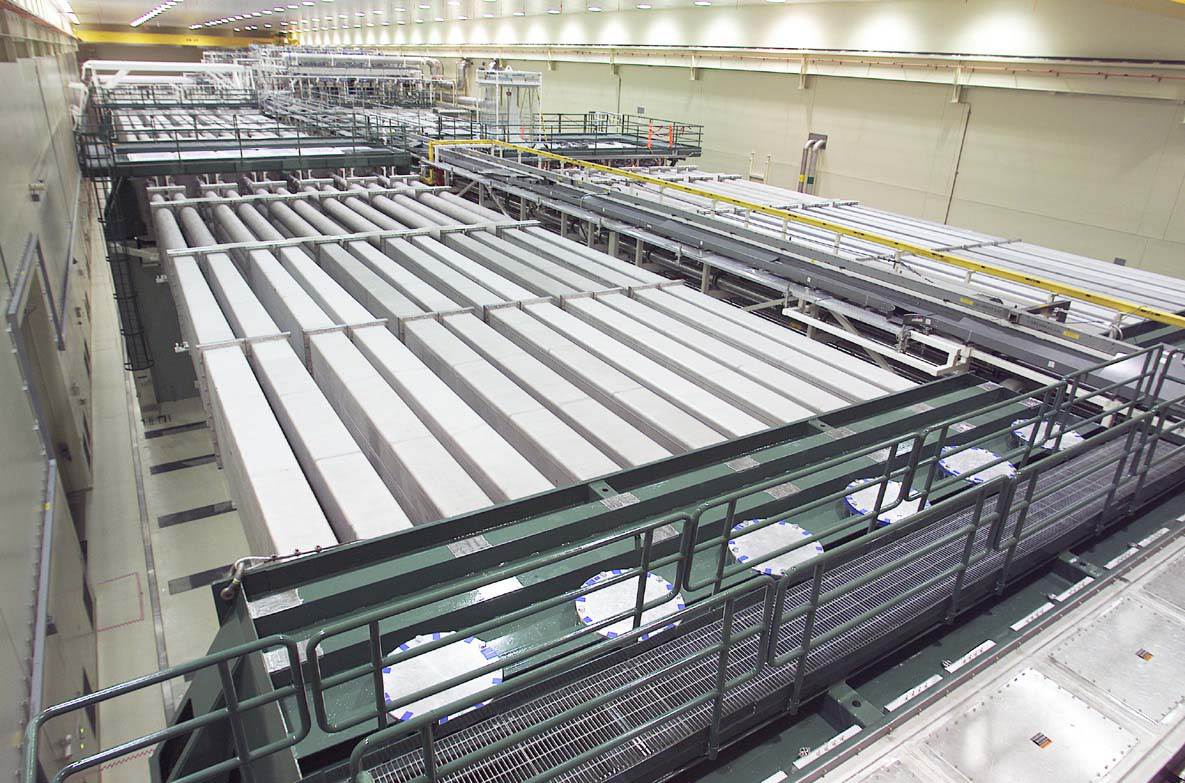 The first of the facility’s two 96-beam laser bays was commissioned at the end of July. Each of the 96 beams fired an infrared output energy of about 22,000 joules, more than enough to meet NIF’s operational and performance requirements. Since then six more eight-beam “bundles” are being commissioned in the second laser bay, and three of these bundles have been operationally qualified.
Overall commissioning of the NIF beamlines is scheduled for 2009.
The laser shots last about 25 billionths of a second, a tiny fraction of the time it takes to blink an eye. Firing the beams requires operation of 2,300 high-quality optics and instrumentation modules and nearly 400 computers running a million lines of control system code.
The tests measure the quality of each beam’s spatial profile and temporal pulse shape. Even though each shot is exceedingly short in time, its energy output and frequency is designed to vary significantly throughout its duration depending on the type of experiments being conducted.
Meanwhile, data gathered from experiments conducted at NIF in 2003-2004 have enabled sophisticated computer simulations that confirm NIF’s ability to reach the energy levels and beam quality required to produce the world’s first demonstration of inertial confinement fusion.
The “NIF Early Light” experiments included four shots using four laser beams at high energy on a full-scale target for the first time. Simulations of the experiments on LLNL’s world-class supercomputers matched the actual experimental data to an unprecedented degree. The experiments and simulations indicate that NIF’s laser beams will propagate effectively in plasma-filled targets designed to achieve fusion ignition and thermonuclear burn.
NIF experiments next year will focus 96 beams on a gold hohlraum (the eraser-sized capsule containing the fusion target) filled with a light gas mixture. Dubbed “Eos” for the Greek goddess of dawn, the experiments will use the first set of beams from the completed laser bay, traveling to the center of the ten-meter diameter target chamber. They are designed to help validate key aspects of the full-scale ignition campaign that begins in 2010.
Subscribe to:
Posts (Atom)