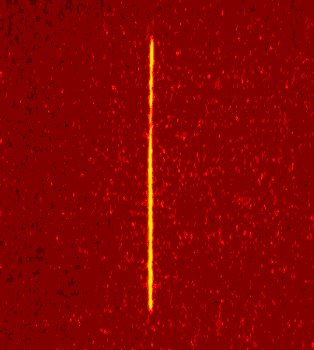
Lasers consist of an active medium of excitable atoms, a pumping mechanism for exciting those atoms, and a cavity for building up a pulse of coherent radiation. At the Institute for Heavy Ion Research (Gesellschaft für Schwerionenforschung, or GSI) in Darmstadt, Germany, scientists have succeeded for the first time in using a beam of uranium ions as the pump for producing ultraviolet laser light.
It works like this: the uranium beam ionizes argon atoms, which ionize krypton atoms, which in turn form excited molecules with fluorine. The krypton fluoride molecules are the excited entities which emit coherent light at a wavelength of 248 nanometers. A laser that uses this rare gas-halide mixture is called an excimer (excited dimer) laser.
This is not the shortest laser wavelength ever achieved, and the uranium pumping scheme is not all that energy efficient. So why then use this approach to producing laser light, especially when electrically pumped commercial krypton fluoride lasers are available? Because this was a test run for producing laser light in excimers that can't be electrically pumped.
According to Andreas Ulrich of the Technical University of Munich (andreas.ulrich@ph.tum.de), the goal is to excite excimers of pure rare gases for producing radiation in the VUV (vacuum ultraviolet) and soft X-ray region of the spectrum. Only now have uranium beams at GSI been powerful enough to provide the pumping power for lasers in this wavelength region. Being so heavy, uranium atoms deposit their energy into a gas much more efficiently that lighter particles such as electrons.
Ulrich et al., Physical Review Letters, 13 October 2006
Contact Andreas Ulrich
Technical University of Munich
andreas.ulrich@ph.tum.de
Copied from Physics News Update 796 #2, October 11, 2006 by Phil Schewe and Ben Stein
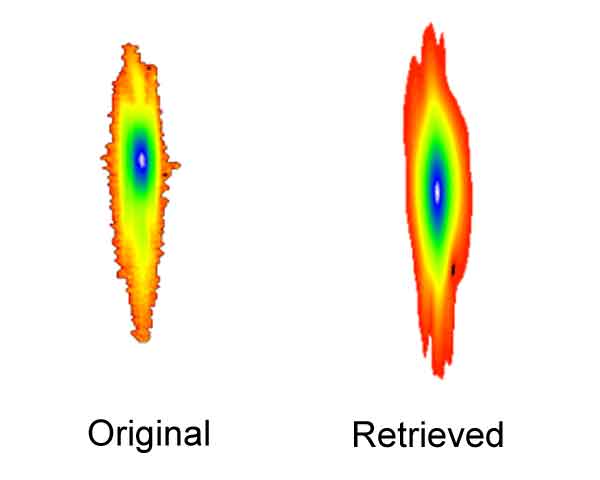
 Electrons, protons and even ions can be accelerated using the extreme electric fields generated when a high-power laser is focused into a plasma. But the structure of the so-called laser wakefields that are driven through the plasma at almost the speed of light — analogous to the wake produced behind by a boat as it travels on water — has until now only been discernable through simulations of the process. Nicholas Matlis and colleagues have produced the first direct images of a laser wakefield, by using a holographic technique that reconstructs an image of the wake structures from the way in which they perturb the interference of two coherent light beams passing through the plasma. The technique provides a new tool for studying laser–plasma interactions and potentially improving the performance of laser-driven particle accelerators.